
Best of ASCO Charlotte 2026: Cancer Survivorship Updates
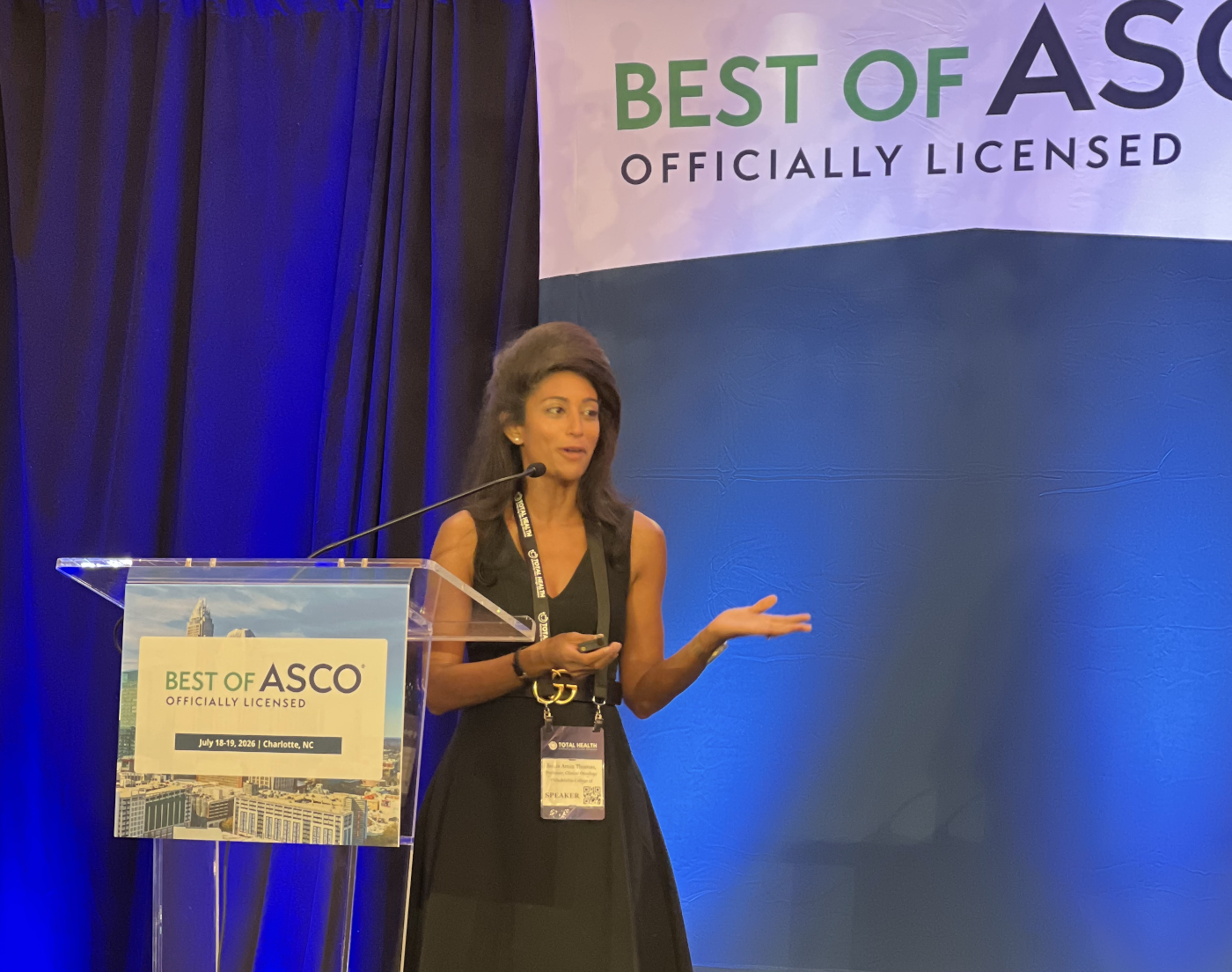
Faculty: Sonia Amin Thomas, PharmD, BCOP, INHC, AFMCP
Professor, Vice Chair, Clinical Oncology Pharmacist
PCOM School of Pharmacy Georgia Campus; Northwest Georgia Oncology at Wellstar North Fulton Medical Center
The Bottom Line
At the 2026 Best of ASCO Charlotte conference presented by Total Health, rather than focusing on a single disease or treatment, Dr Sonia Amin Thomas explored how the concept of cancer survivorship is evolving across the oncology continuum. Reviewing ten abstracts presented at the 2026 ASCO Annual Meeting, she emphasized that survivorship is no longer limited to surveillance after treatment. Instead, it is increasingly encompassing lifestyle interventions, digital health technologies, and supportive care strategies designed to improve both quality as well as quantity of life. Throughout her presentation, she challenged clinicians to think beyond traditional therapies and consider how exercise, nutrition, symptom management, and personalized survivorship programs can become integral components of routine cancer care.
Although several of the studies presented were exploratory, Dr.Thomas identified four that she believes are ready to influence clinical practice, specifically, the CHALLENGE trial evaluating structured exercise after colon cancer, the BWEL weight-loss intervention in breast cancer survivors, the YOCAS yoga program for symptom management, and the DESCEND trial evaluating steroid-sparing antiemetic therapy. Other studies she highlighted including those evaluating GLP-1 receptor agonists, digital survivorship platforms, multicancer early detection (MCED) testing, short-term fasting, and bupropion for cancer-related fatigue she viewed as promising but requiring additional validation before routine adoption into clinical practice.
Background
Dr Thomas organized her presentation across three broad themes that she believes are reshaping survivorship care: diet and exercise, survivorship technologies, and supportive care. While each category included several new ASCO abstracts, she repeatedly returned to the larger question facing clinicians – that is, how can survivorship care improve outcomes without relying solely on new drugs? As an oncology pharmacist, Dr Thomas approached each study with a practical lens, distinguishing between findings that are immediately actionable and those that are simply hypothesis-generating. She reminded the audience that exciting data are not necessarily always practice changing and encouraged clinicians to evaluate each study according to its strength of evidence, feasibility, and applicability in everyday practice.
One recurring message throughout her presentation was that survivorship is becoming increasingly multidisciplinary. Exercise specialists, dietitians, pharmacists, physical therapists, behavioral coaches, and digital health platforms all have expanding roles in helping patients maintain health after treatment. Rather than viewing survivorship as a series of annual follow-up visits, Dr Thomas envisioned it as an ongoing, personalized process supported by an integrated care team.
Results from ASCO 2026: Lifestyle Medicine Moves into Mainstream Oncology
Perhaps the strongest message from Dr Thomas’ presentation was that lifestyle interventions are beginning to accumulate evidence comparable to many traditional supportive care strategies. Among the studies she chose to review, Dr Thomas considered the CHALLENGE trial to be the most practice changing. CHALLENGE evaluated a structured exercise program for patients who had completed adjuvant chemotherapy for colon cancer. Unlike general recommendations encouraging physical activity, participants received individualized coaching from certified cancer exercise specialists over three years. Although the program required substantial upfront investment, investigators demonstrated improvements in disease-free survival, overall survival, quality-adjusted life years, and overall cost-effectiveness. The findings of the trial were sufficiently compelling that structured physical activity has already been incorporated into the NCCN Colon Cancer Guidelines, which now recommend discussing and facilitating at least 150 minutes of moderate to vigorous exercise each week.
Dr Thomas acknowledged that implementing structured exercise programs may be challenging in many community practices because access to certified exercise specialists remains limited. Nevertheless, she encouraged clinicians to begin incorporating referrals to physical therapists, exercise physiologists, and/or survivorship programs whenever possible, emphasizing that exercise should now be viewed as part of cancer treatment rather than simply healthy lifestyle advice.
Dr Thomas also highlighted the BWEL trial, which demonstrated that telephone-based weight-loss coaching produced sustained weight reduction and meaningful improvements in physical function, fatigue, and quality of life among breast cancer survivors with overweight or obesity. Rather than attributing the benefits solely to dietary counseling, Dr Thomas suggested the intervention illustrated the value of incorporating accountability. The weekly coaching calls helped patients remain engaged with their goals, she noted, which reinforces the importance of behavioral support alongside medical management. She believes these findings further strengthen the growing evidence that obesity represents an important, modifiable survivorship risk factor in breast cancer.
A third lifestyle intervention which Dr Thomas highlighted focused on yoga. The YOCAS trial evaluated a standardized four-week program of restorative and gentle Hatha yoga among cancer survivors who were experiencing persistent sleep disturbances. Participants experienced improvements in insomnia, fatigue, mood disturbance, and anxiety without meaningful adverse effects. Dr Thomas noted that both ASCO and the Society for Integrative Oncology already recommend yoga for selected survivors, and she expects these new data to further reinforce those recommendations. Because yoga is inexpensive, widely accessible, and associated with minimal risk, she believes it represents a practical intervention that clinicians can confidently recommend for survivors experiencing persistent symptoms like sleep disturbance.
Not every lifestyle intervention which Dr Thomas reviewed from ASCO 2026 was ready for implementation, however. She discussed a pilot trial evaluating short-term fasting around chemotherapy in ovarian cancer, which generated considerable interest because of its potential effects on metabolism and treatment response. While the investigators observed encouraging signals for the intervention, including improvements in progression-free survival and metabolic endpoints, she emphasized that the study enrolled only 54 patients and ultimately analyzed just 18 participants because of poor adherence and attrition. As such, Dr Thomas viewed the study as an intriguing proof of concept but cautioned against changing practice summarizing succinctly: "Would you apply this to any patient? No, definitely not." Similarly, she notes several observational studies which suggested that GLP-1 receptor agonists may reduce cancer progression or lower the risk of certain malignancies, particularly breast cancer. Although these findings generated considerable attention during ASCO, Dr Thomas emphasized that they remain observational and should not prompt clinicians to prescribe GLP-1 therapies specifically for cancer prevention. Instead, she views these studies as an important foundation for future prospective research.
Survivorship Care Becomes Increasingly Digital
Another major theme of Dr Thomas’ presentation was the rapid expansion of digital survivorship tools. She noted the SUPPORT+ study, which demonstrated that a digital symptom-management platform was reduced unplanned hospitalizations and shortened inpatient stays among patients with advanced cancer by combining automated self-management advice with rapid nurse follow-up to address severe symptoms. Although compliance declined over time and the study included a notably older population with a median age of 78 years, Dr Thomas believes the findings illustrate the growing role of digital symptom monitoring in oncology care.
She also reviewed the YES trial, which evaluated a mobile health application for adolescent and young adult breast cancer survivors. Rather than simply providing educational materials, the application generated individualized survivorship recommendations based on each patient's treatment history and concerns. The intervention reduced anxiety surrounding recurrence, long-term health effects, and other survivorship issues by delivering evidence-based guidance tailored to individual patients. Dr Thomas believes these personalized approaches will become increasingly common as survivorship care evolves.
To help clinicians incorporate these findings immediately, she also recommended several freely available resources, including ACS CARES, Cancer Buddy, and MD Anderson's Cancer Survivorship Algorithms, noting that these currently available applications can provide practical support even before more sophisticated digital platforms become more widely used in clinical practice.
Update on Multi-Cancer Early Detection
Dr Thomas also reviewed results from the NHS-Galleri trial evaluating a blood-based multicancer early detection test. Although the study failed to achieve its primary endpoint of reducing stage III and IV cancer diagnoses, it demonstrated encouraging secondary findings, including fewer stage IV cancers, more early-stage diagnoses, and fewer cancers presenting through emergency departments. While she believes blood-based screening technologies represent an exciting direction for cancer detection, she stressed that Galleri should not replace established screening methods until larger studies demonstrate improvements in survival and cost-effectiveness.
Supportive Care Continues to Evolve
Dr Thomas concluded her presentation by reviewing two supportive care studies with distinctly different implications for clinical practice. The DESCEND trial evaluated strategies to reduce or eliminate dexamethasone as part of antiemetic prophylaxis for patients receiving highly emetogenic chemotherapy. Investigators found that a single day of dexamethasone combined with NEPA and olanzapine maintained efficacy comparable to the traditional four-day regimen while reducing steroid exposure. She believes this represents an important advance, particularly as immunotherapy combinations become increasingly common and clinicians seek to minimize unnecessary corticosteroid use. She noted that patients with diabetes, insomnia, mood disorders, or other steroid-related complications may particularly benefit from this approach.
In contrast, Dr Thomas also noted a randomized trial evaluating bupropion for cancer-related fatigue which produced mixed results. Results showed that women experienced modest improvements in fatigue, whereas men did not appear to benefit. Because the male sample size was relatively small and fatigue remains a complex, multifactorial symptom, Dr Thomas concluded that additional research will be needed before bupropion can be routinely recommended for cancer-related fatigue.
Conclusions and Faculty Insights
Dr Thomas concluded by asking perhaps the most practical question of the session: "So what do I do with all of this on Monday in practice?" Her answer reflected a thoughtful distinction between innovation and implementation. She believes clinicians can begin incorporating structured exercise programs, weight-loss interventions, yoga, and steroid-sparing antiemetic strategies into survivorship care today because the evidence supporting these approaches is sufficiently mature. In contrast, emerging areas such as GLP-1 receptor agonists, multicancer blood-based screening, digital survivorship platforms, short-term fasting, and pharmacologic management of cancer-related fatigue remain promising but require additional prospective validation before routine adoption. Ultimately, Dr Thomas believes that survivorship is undergoing a fundamental transformation. Rather than focusing exclusively on surveillance for recurrence, future survivorship care will likely become increasingly proactive, personalized, and multidisciplinary, integrating lifestyle medicine, digital technologies, and supportive care strategies alongside traditional oncology follow-up.
Dr Thomas summarized the evolving landscape in survivorship as reported at ASCO 2026 with three overarching observations:
"Lifestyle medicine is becoming a big part of oncology."
"Survivorship is becoming digital… and personalized."
"Better supportive care… with less toxicity."
Speaker Disclosure Information: Dr Amin Thomas reported no relevant disclosures for this presentation.