
Management of HER2-Positive Metastatic Breast Cancer: A 2025 Update with Dr Angela DeMichele
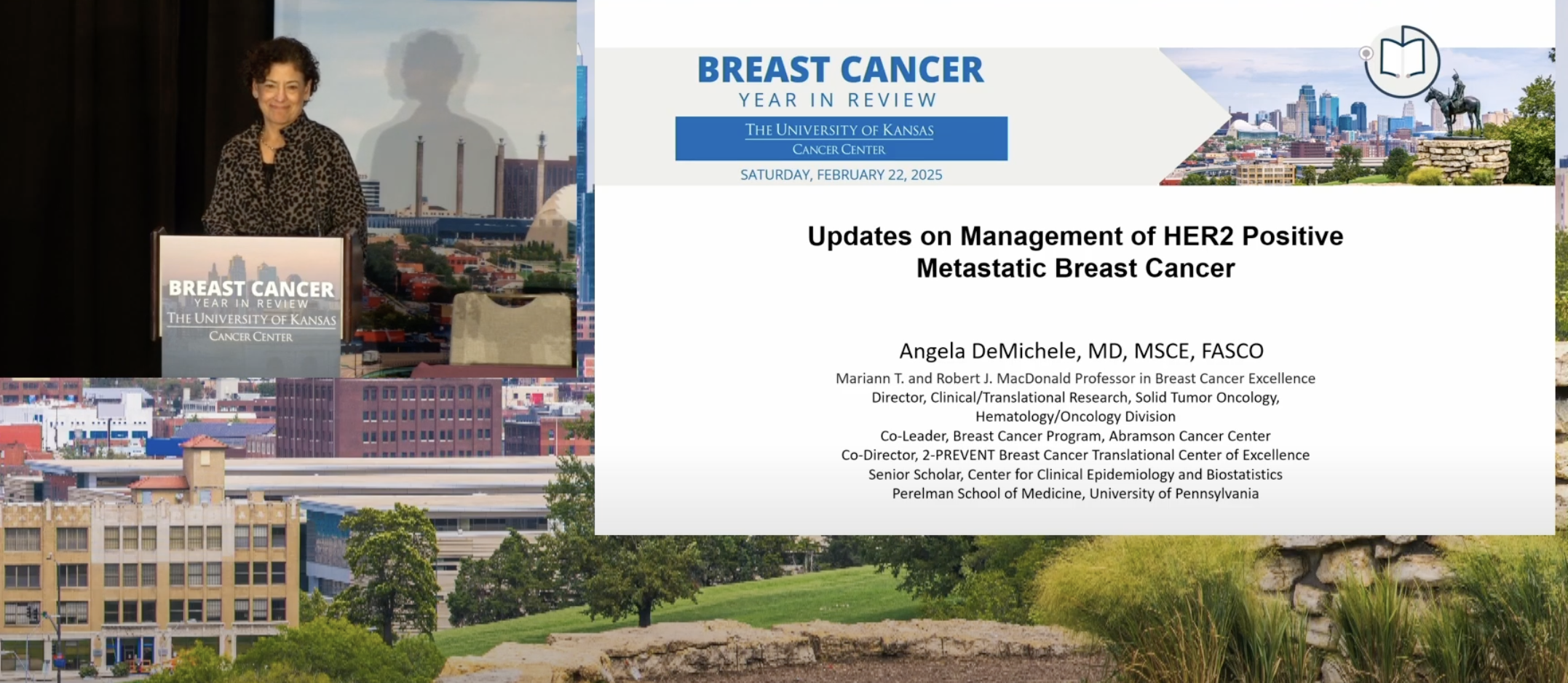
Presenter:
Angela DeMichele, MD, MSCE, FASCO
Conference:
2025 University of Kansas Breast Cancer Year in Review
Setting the Stage: A Rich Foundation, and a Path to Build Upon
At the 2025 University of Kansas Breast Cancer Year in Review Conference presented by Total Heath, Dr Angela DeMichele from the Abramson Cancer Center, University of Pennsylvania presented on the evolving management landscape for patients with Human epidermal growth factor receptor 2 positive (HER2+) metastatic breast cancer (MBC). Commenting on the dramatic expansion of treatment options in this patient subset, she noted “We’ve come a long way… but the question is: Can we build on our solid foundation to improve outcomes even further?” Dr DeMichele focused her presentation on four main areas: HER2+/estrogen receptor (ER)+ disease and the recent PATINA trial; the role (and limitations) of immunotherapy in HER2+/ER– disease; the emerging relevance of biomarkers like HER2DX and BRCA status; and new CNS-penetrant agents which are poised to reshape management for HER2+ breast cancer patients with brain metastases.
The PATINA Trial: A New Standard for HER2+/ER+ MBC
The PATINA trial was a landmark phase III study investigating whether adding the cyclin-dependent kinase 4/6 inhibitor (CDK4/6i) palbociclib to standard HER2-targeted therapy and endocrine therapy (ET) could extend progression-free survival (PFS) in patients with HER2+/ER+ MBC. HER2+ patients in the trial were enrolled after completing their standard induction chemotherapy with a taxane plus trastuzumab and pertuzumab (THP). They were randomized to receive maintenance therapy with HER2-directed antibodies and ET either with or without palbociclib.
Key Findings from the trial showed an increase in the median PFS from 29.1 months to 44.3 months with the addition of palbociclib to ET (hazard ratio [HR] = 0.74). Notably, there were no unexpected safety signals reported, and the percentage of Grade ≥4 adverse events were similar between arms. Dr DeMichele noted that overall survival (OS) data from the trial are as yet immature, however, early results suggest durable benefit. She emphasized, “This is a practice-changing study. All HER2+/ER+ patients should now receive endocrine therapy during maintenance—and I believe palbociclib should be included as well.” She further highlighted that the findings from PATINA raise several new questions; first, can some patients forego chemotherapy altogether and move directly into ET + HER2 blockade, secondly, will other CDK4/6 inhibitors confer similar benefit in this setting, and third, how will emerging antibody drug conjugates (ADCs) such as trastuzumab deruxtecan (T-DXd) fit into second-line therapy for these patients?
HER2+/ER– Disease: The Challenge of Immune Checkpoint Inhibition
Dr DeMichele noted the strong rationale for using immune checkpoint inhibitors (ICIs) in HER2-positive breast cancer, as these tumors frequently display immune-responsive features such as high levels of tumor infiltrating lymphocytes (TILs), increased programmed death ligand (PD-L1) expression, and a high tumor mutational burden. Despite these observations, however, clinical success with ICIs in this setting has proven difficult—and potentially dangerous. She reviewed results from multiple trials, including PANACEA, KATE2, and IMpassion050, which failed to show meaningful benefit with ICIs and raised red flags about treatment toxicity. In particular, she noted the NRG-BR004 trial, which added the ICI atezolizumab to standard first-line THP therapy, which was halted due to an imbalance in treatment-related deaths. Dr DeMichele noted “There was a 6% treatment-related mortality in the atezolizumab arm…That’s not something we can ignore.” In addition, while a numerically higher PFS was observed in the ICI arm, no OS benefit was seen, leading to the key takeaway that, at present, there is no role for ICIs in HER2+ MBC, and further investigation is needed to clarify the mechanisms behind the observed toxicity with these agents.
Biomarkers: From HER2DX to BRCA and Beyond
With the growing number of therapeutic options, Dr DeMichele noted that selecting the right drug for the right patient has become more critical than ever. In this regard, she reviewed data for some of the current biomarkers under development, focusing on HER2DX and insights from the DESTINY-Breast03 trial biomarker analyses.
Dr DeMichele noted that, in a correlative analysis from the CLEOPATRA trial, patients with high HER2DX ERBB2 mRNA expression had better PFS (20.3 vs. 10.4 months) and OS (73 vs. 40.3 months) as compared to those with low expression. “This isn’t just prognostic,” she explained. “It could help guide frontline therapy selection—especially as ADCs move up [to earlier treatment lines].”
In the DESTINY-Breast03 Biomarker Analysis, Dr DeMichele noted that T-DXd was superior to the comparator, trastuzumab emtansine (T-DM1), across all biomarker subgroups (PFS 28.8 vs. 6.8 months). Despite these findings, however, patients with homologous recombination deficient status (HRD+), or those with BRCA-mutated tumors had shorter PFS on T-DXd, suggesting potential resistance to this ADC. She further noted that emerging mutations in other genes like TOP1 may also play a role in acquired resistance to ADCs. “These are hypothesis-generating data… But they suggest that BRCA and HRD status might matter more than we thought when choosing between T-DXd and other agents.”
CNS Metastases: Hope on the Horizon with ZN-1041
Dr DeMichele noted the sobering statistic that approximately 30–50% of patients with HER2+ MBC will develop CNS metastases during their disease course. While tyrosine kinase inhibitor (tucatinib)-based regimens such as that used in the HER2CLIMB trial have shown promise, limitations of these therapies remain, largely as a result of inadequate blood-brain barrier penetration. She noted the emergence of agents like ZN-1041, a novel HER2-selective tyrosine kinase inhibitor developed to overcome this barrier.
In Phase I/II results presented at the 2024 San Antonio Breast Cancer Symposium (SABCS), when combined with capecitabine and trastuzumab, ZN-1041 demonstrated a central nervous system (CNS) objective response rate (ORR) of 64.9%, and the observed intracranial PFS reached 17.4 months. Overall toxicity in the trial was manageable, but she noted that further refinement of dosing with this agent is needed. Overall, Dr DeMichele thought “This could challenge tucatinib’s role in CNS disease—though we’ll need head-to-head data. It’s a strong signal that better brain-penetrant drugs are coming, and we must determine how to integrate them with ADCs.”
Conclusion: A Thoughtful Call for Precision
Summarizing her presentation, Dr DeMichele called for a rethinking of the way HER2+ MBC is currently categorized: “I no longer think of this as HER2+ disease with some ER positivity,” she said. “I think of it as ER+ disease that also happens to express HER2. That shift in perspective changes how we treat.” She further emphasized that future treatment strategies must move beyond one-size-fits-all approaches and be informed by molecular signatures, clinical context, as well as patient preferences.
Management of HER2+ MBC: Key Takeaways
The PATINA trial establishes a new standard: Palbociclib + HER2-targeted therapy + ET significantly prolongs PFS in HER2+/ER+ MBC.
ICIs remain investigational in HER2+ MBC and are currently not recommended due to safety concerns.
Biomarkers like HER2DX and BRCA/HRD status may help guide therapy selection, especially as ADCs move earlier in the treatment paradigm.
ZN-1041 shows promise for CNS disease, offering new hope for patients with brain metastases.
Future care will rely on precision, personalization, and smarter sequencing of the growing armamentarium.
“This is an exciting time in HER2+ breast cancer. But more than ever, we need to think carefully—not just about what works, but about what works for whom...”
You can see the full presentation by Dr DeMichele from the 2025 University of Kansas Breast Cancer Year in Review here.
Speaker Disclosure Information: Dr DeMichele reported no relevant disclosures for this presentation.