
Primary Care to Oncology – Conversations for Change: Dr Kittaneh On Cancer Genomics for Primary Care
Speaker:
Muaiad Kittaneh, MD, MBA, FACP – Senior Director, ICON
Conference:
2025 Health Equity: Primary Care to Oncology—Conversations for Change
Introduction
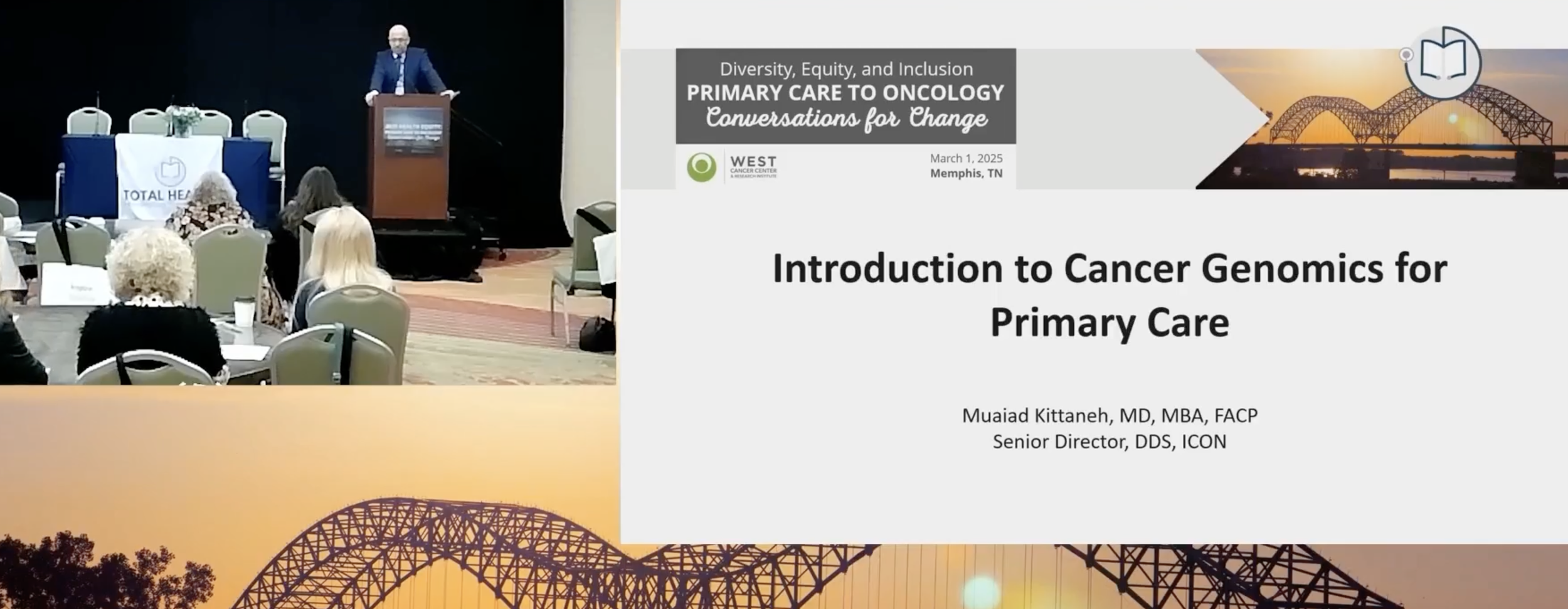
At the 2025 Health Equity Primary Care to Oncology—Conversations for Change conference presented by Total Health, Dr Muaiad Kittaneh, Senior Director at ICON presented an overview of cancer genomics for primary care physicians (PCPs). He noted that cancer genomics lies at the intersection of genetics and clinical oncology, and Dr Kittaneh believes that the field should no longer be siloed within oncology but rather translated meaningfully into primary care practice. “Sometimes detecting these mutations provides new options, new treatments, new horizons for patients and their families.” Dr Kittaneh noted. Speaking to the largely primary care audience in Memphis, TN, Dr Kittaneh emphasized that equipping our ‘frontline providers’ with genomic literacy is a crucial step to provide equitable, early detection and targeted intervention for hereditary and somatic mutations in cancers.
Genes, Genomes, and the Building Blocks of Cancer
Dr Kittaneh began his presentation with some foundational definitions—highlighting the distinction between genetics (the study of individual genes) and genomics (the study of the entire genome). Genomics, he explained, involves the use of different tools and diagnostic tests that offer a holistic view of an individual’s genetic makeup, and enables insight into inherited and acquired mutations that can fuel cancer. Dr Kittaneh noted that cancer emerges from an accumulation of mutations—each one a small misfire in the body’s DNA replication machinery. He further noted that such alterations are not created equal. While some may be benign, or of uncertain significance, others—when they disrupt key molecules such as cell cycle regulators—can drive malignancy.
Somatic vs. Germline: The Clinical Divide
Dr Kittaneh also stressed the critical difference between somatic mutations, which occur in a non-inheritable fashion and are acquired during one’s life, versus germline mutations, which are passed from parent to child and underlie hereditary cancer syndromes. He noted that somatic mutations are typically detected in tumor tissue or blood, while germline alterations are found in saliva or blood samples and reflect a systemic genetic risk. Dr Kittaneh noted that most hereditary cancers are inherited in an autosomal dominant pattern—affecting both sexes equally, without skipped generations.
Cancer Drivers: When Genes Misfire
Using the analogy of an automobile, Dr Kittaneh guided the audience through the cellular mechanics of oncogenes (the gas pedal for growth) and tumor suppressor genes (the brake for growth). “If tumor suppressor genes are like brakes in a car,” he said, “then a mutation that inactivates them is like losing the brakes entirely—and the cells grow unchecked.” He used the example of the BRCA1 and BRCA2 genes which, when mutated, dramatically increase risks for breast, ovarian, and other cancers. For example, the lifetime risk of breast cancer for BRCA1 carriers, he noted, can be as high as 87%, and affected individuals have a 64% chance of developing a second primary tumor. Despite these risks, however, Dr Kittaneh noted that with early identification of individuals at risk, patients can access powerful preventive options. These can include enhanced screening with MRI, risk-reducing surgeries, and possibly chemoprevention strategies. “We can reduce ovarian cancer risk by up to 98% in BRCA1/2 carriers with bilateral salpingo-oophorectomy,” he noted.
Clinical Utility of Genomics in Practice
From the perspective of primary care practice, Dr Kittaneh emphasized that genomics is no longer confined to clinical research and academic laboratories. Rather, in oncology, genomic tests provide key information such as: Identifying at-risk patients, such as those with hereditary cancer syndromes, Early detection and screening, with emergent technologies such as blood-based multi-cancer screening, Prognostication and therapy selection in cancer using genomic classifier tools such as OncotypeDx, MammaPrint, and others, and more recently, Monitoring for residual disease and treatment resistance using minimal residual disease (MRD) testing assays like ColoSeq™ or liquid biopsies. AS a real-world example, Dr Kittaneh shared the case of a woman with a BAP1 germline mutation, whose recurring abdominal pain had been misattributed to colitis. Only through careful genomic investigation, he noted, was her actual underlying condition of mesothelioma identified. “If we don’t interpret the test carefully,” Dr Kittaneh emphasized, “patients can suffer harm from either over- or under-treatment.”
Ethical and Legal Considerations
Dr Kittaneh also reviewed some of the legal and ethical implications of genetic testing. For example, he noted that with genetic information can also come emotional distress, fear of discrimination, and confidentiality concerns. He emphasized that autonomy, justice, beneficence, and non-maleficence should guiding ethical principles in this regard. He further noted that while national policy initiatives such as GINA (the Genetic Information Nondiscrimination Act) can protect patients from health insurance and employment bias, it does not extend to other critical assets such as life, disability, or long-term care insurance. “It’s important that patients understand that a positive test doesn’t mean they will get cancer…” he noted, “…nor does a negative test eliminate their risk.”
The Role of Primary Care and Genetic Counseling
Summarizing, Dr Kittaneh noted that primary care providers play a vital role in recognizing red flags for patients, initiating genetic testing when appropriate, and referring to genetic counselors, who can assist with education, family planning, and psychosocial support. “There’s a lot of uncertainty in variants of unknown significance (VUS),” he cautioned. “That’s where [genetic] counselors are essential.” Dr Kittaneh concluded by encouraging ongoing curiosity. Cancer genomics, he said, is evolving rapidly—from DNA to RNA to protein to the metabolome and microbiome. “Each layer gives us new clues. We’re looking for a molecular signature that defines risk, prognosis, and treatment response.”
“This is a field that is growing faster than most can keep up with… But by involving primary care earlier in the genomic journey, we can reach more patients before the cancer has a chance to take hold.”
Speaker Disclosure Information: Dr Kittaneh reported no relevant disclosures for this presentation.