
Adjuvant Endocrine Therapy in HR+ Breast Cancer: Clinical Insights from Dr Matthew Goetz
Presented by:
Matthew P. Goetz, MD, Mayo Comprehensive Cancer Center
Conference:
2025 University of Kansas Breast Cancer Year in Review
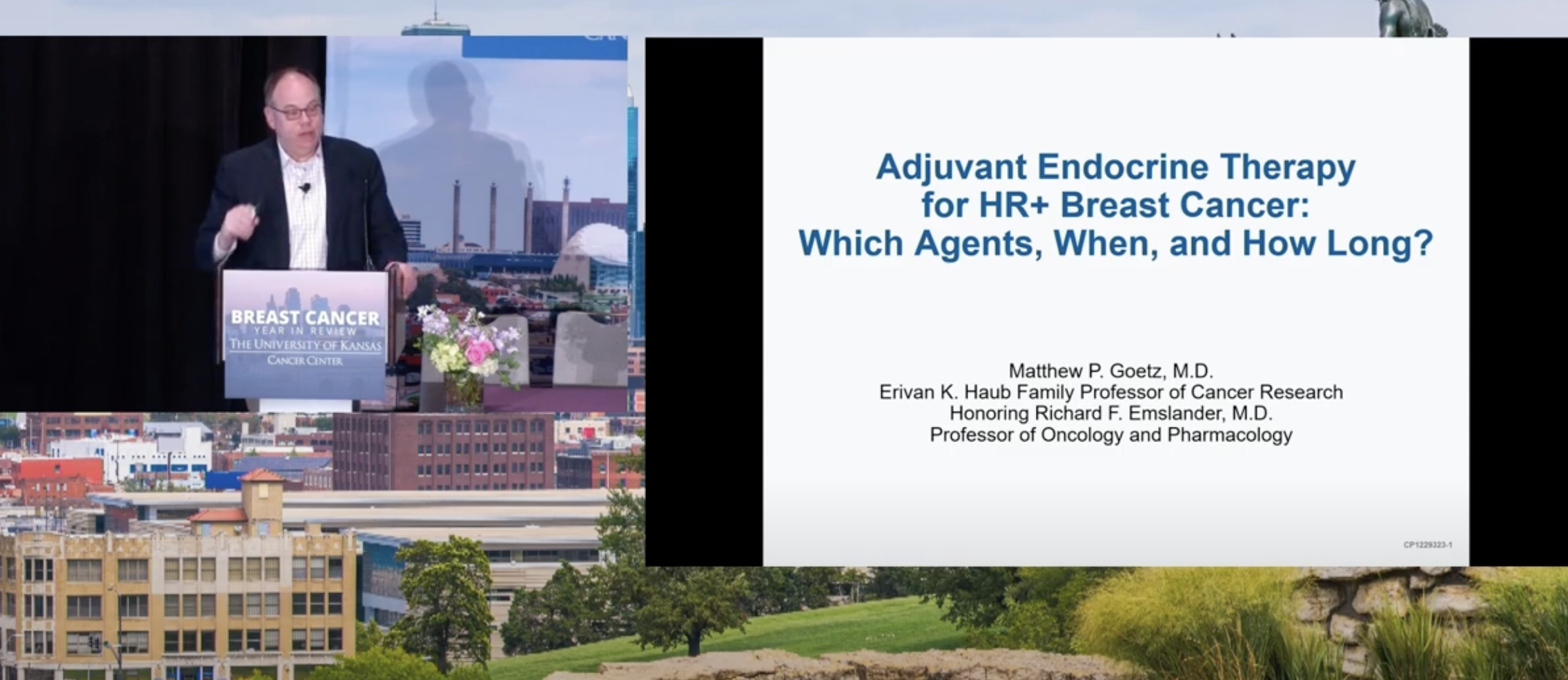
Introduction: A Key Takeaway – “Give Endocrine Therapy”
At the 2025 University of Kansas Breast Cancer Year in Review Conference presented by Total Heath, Dr Matthew Goetz from the Mayo Clinic was clear in emphasizing a single point: Patients with hormone receptor–positive (HR+) breast cancer should receive adjuvant endocrine therapy (ET). He noted that, despite decades of clinical progress, the real-world data show an overall suboptimal uptake of ET, especially in certain patient subsets, such as those with low levels of estrogen receptor, or ‘ER-low’ disease. Key points of his presentation included which ET agents to use, for how long, and in which patients is escalation or de-escalation of therapy appropriate - drawing upon both foundational evidence and the latest trial data.
A Rising Incidence of ER+ Disease in Premenopausal Women
Dr Goetz began by highlighting the current troubling epidemiological trends, noting the ER-positive breast cancer rate has been steadily increasing, particularly in premenopausal women. “This is being referred to now as an emerging epidemic,” he noted, referencing recent data from JAMA Open and CA: A Cancer Journal for Clinicians.
He noted that, while screening practices have not changed overall, environmental and metabolic factors—such as increasing body mass index (BMI) in the population may be key drivers of this trend. Despite the rising incidence, however, Dr Goetz noted that the important endpoint of breast cancer mortality continues to decline, thanks to improved screening and treatment.
The Proven Value of Endocrine Therapy
Dr Goetz underscored the magnitude of benefit from ET, citing results from the Early Breast Cancer Trialist’s Collaborative Group (EBCTCG) which estimated that, compared to no therapy, aromatase inhibitors (AIs) reduce breast cancer recurrence by about two-thirds during treatment. Moreover, Dr Goetz noted the apparent “carryover effect” of ET, with continued separation of survival curves even after treatment completion—which has been well documented since the seminal meta-analyses from the EBCTCG.
Despite the benefit, however, Dr Goetz noted that, in real-world clinical practice, adherence to ET remains inconsistent and suboptimal. In this regard, Dr Goetz presented National Cancer Database (NCDB) data showing that patients who omit ET after neoadjuvant chemotherapy (NAC) experience a 1.7-fold higher risk of death for patients with estrogen receptor positive, Human epidermal growth factor receptor 2 negative (ER+/HER2–) disease, with a 1.6-fold increase also observed in HER2+ cases. “Just because you’re giving HER2-directed therapy doesn’t mean you can ignore the estrogen receptor,” Dr Goetz noted. “There’s crosstalk between these pathways.”
ER-Low Disease: An Area of Clinical Uncertainty
For patients with ER expression between 1–10%—typically classified as ‘ER-low’—Dr Goetz noted the role of ET is controversial. He noted that these tumors are biologically closer to triple-negative breast cancer (TNBC), and data supporting ET benefit have been lacking. Findings from a large NCDB cohort (2018–2020), found that, among >350,000 stage I–III ER+ breast cancers, 10,362 (3%) were classified as ER-low, and in this ER-low subset, roughly 45% omitted ET. Results showed that in patients with residual disease after NAC, ET omission led to a 7% absolute reduction in overall survival. In view of these data, Dr Goetz made the recommendation of retesting for ER expression in tumors with residual disease post-NAC. “Tumor heterogeneity is real,” he explained. “You can stick a needle in one part of the tumor and miss the ER-positive clone entirely.” He further noted data from the Mayo Clinic that will be presented at the American Society for Clinical Oncology (ASCO) Meeting, demonstrating tumor heterogeneity. For those with ER low disease prior to chemotherapy, those found to have residual disease at surgery will have an increase in the percentage of cells that are ER-positive. If the ER is not targeted, patients will not obtain the benefit of endocrine therapy.
CDK4/6 Inhibitors in the Adjuvant Setting: monarchE and NATALEE
With regard to the use of cyclin-dependent kinase 4/6 inhibitors (CDK4/6i), Dr Goetz reviewed data from two key trials evaluating their use in high-risk, hormone receptor positive/HER2– early breast cancer. The monarchE trial included patients with ≥4 positive nodes or 1–3 nodes plus grade 3 or large tumors, and patients received treatment with 2-years of a CDK4/6i (abemaciclib) + ET or ET alone. The results showed a sustained benefit in both invasive disease free survival (IDFS) as well as distant recurrence-free survival (DRFS) at 5 years, with a 7.6% and 6.7% improvement in these respective endpoints. In addition, Dr Goetz noted that while improvement in overall survival (OS) has not yet been observed, fewer patients in the abemaciclib arm developed metastatic disease. A key takeaway from the trial, Dr Goetz noted was that “Even after stopping therapy at two years, the benefit continues… That is either a true carryover effect—or a durable impact of early intervention.” Dr Goetz also cited results from the NATALEE trial with broader eligibility criteria, including node-negative patients with high genomic risk. Patients in the trial received a CDK4/6i (ribociclib) with a nonsteroidal aromatase inhibitor (NSAI) or an NSAI alone, for 3 years of treatment. The results showed an absolute IDFS improvement of 3.1% at 3 years, and a DDFS improvement of 2.7%, with a benefit observed in both node-negative and node-positive patients. Taken together, Dr Goetz noted that both abemaciclib and ribociclib now represent viable options for escalation of adjuvant therapy, although the patient populations studied in these trials differ.
ESR1 Mutations, Primary Resistance, and Biomarkers
Dr Goetz also reviewed some of the molecular mechanisms of ET resistance, which can include mutations in the estrogen receptor gene (ESR1) that confer resistance to aromatase inhibitors (AIs), growth factor pathway activation such as epidermal growth factor receptor (EGFR) and HER2 pathways, and tumors with high proliferation signatures, which can be seen in selected patients, such as those with the Luminal B phenotype. In this regard, he noted that genomic profiling using the Oncotype recurrence score correlates strongly with the degree of ER expression, not just proliferation, and that this could explain, in part, why ‘low ER’ tumors tend to fall into higher-risk genomic categories. For premenopausal women, Dr Goetz noted the small but consistent benefit of chemotherapy that has been observed in trials like TAILORx, RxPonder, and MINDACT, which could be reflective of inadequate endocrine therapy regimens (i.e., tamoxifen monotherapy). Dr Goetz noted the ongoing BR009 trial which is currently testing whether optimal endocrine therapy using ovarian suppression with an AI is superior to chemotherapy plus ovarian suppression.
Extended Adjuvant Endocrine Therapy: A Modest but Meaningful Tool
In the final portion of his presentation, Dr Goetz addressed the lingering question of whether ET should be continued beyond 5 years for patients at higher risk for late recurrence. He noted additional data from the EBCTCG meta-analysis, including a soon-to-be-published update focused on the use of extended ET using an AI after an AI; the results of this analysis show a 25% relative reduction for both recurrence and distant recurrence. While there has been no observed OS benefit as yet, Dr Goetz noted that follow-up for this endpoint may be insufficient; he also noted there was a greater absolute benefit in node-positive patients. Dr Goetz stressed that, because the overall benefit of extending ET is modest, patient selection is key, and risk assessment tools like the CTS5, molecular profiling using tolls like the Breast Cancer Index (BCI), as well as, in the future, circulating tumor DNA (ctDNA) detection for minimal residual disease (MRD) which may be useful to help personalize decisions on extending ET.
The Final Message: Stay the Course with Endocrine Therapy
Summarizing, Dr Goetz highlighted what he frequently says to his patients: “You just got through 20 weeks of chemotherapy… You were sick, you lost your hair, you were exhausted… And now the hard part begins—taking a pill every day.” He emphasized that adherence to ET remains a critical—and often underappreciated—determinant for improving long-term outcomes. As such, he urges clinicians to encourage compliance and persistence with ET, reassess ER status when appropriate, consider escalation with CDK4/6i for patients with high-risk disease, and to use extended AI therapy for select node-positive patients.
Adjuvant ET in HR+ Breast Cancer: Key Takeaways
Adjuvant endocrine therapy saves lives. It should be offered and encouraged for all eligible patients.
Omission of ET is harmful, even in patient with HER2+ and ER-low tumors with residual disease.
ER status should be re-checked post-NAC in patients with ER low, large, or heterogeneous tumors.
CDK4/6 inhibitors (abemaciclib, ribociclib) offer durable benefit in high-risk early breast cancer.
Extended endocrine therapy (using an AI after AI) reduces recurrence, especially in patients with node-positive disease.
Future tools like ctDNA testing and genomic classifiers may help to further refine duration of ET and escalation decisions.
“Give endocrine therapy. It is the single most effective intervention we have for HR+ breast cancer.”
You can see the full presentation by Dr Goetz from the 2025 University of Kansas Breast Cancer Year in Review here.