
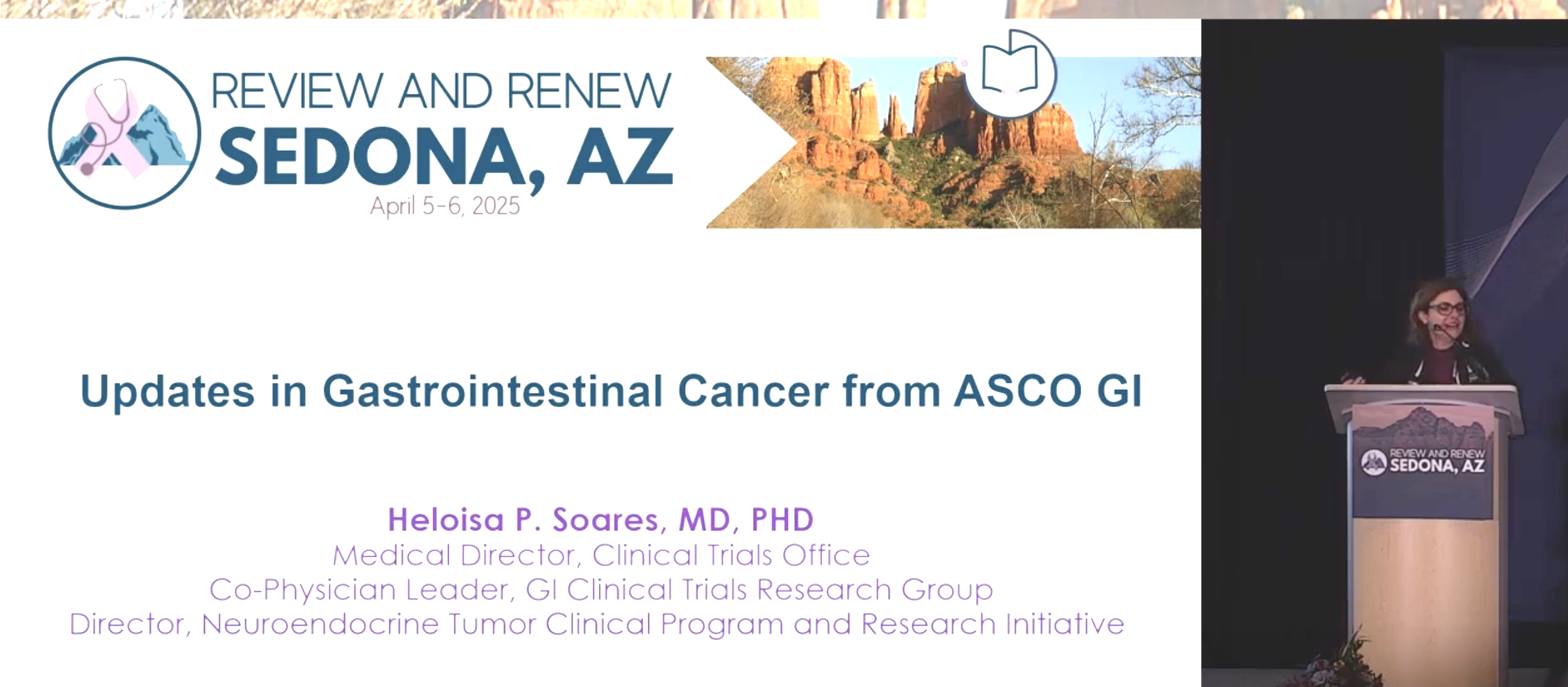
2025 Review and Renew Sedona: Updates from ASCO GI with Dr Soares
Presented by:
Heloisa Soares, MD, PhD, Huntsman Cancer Institute
Conference:
2025 Review and Renew Sedona
Case-Based Learning to Reflect Real-World Scenarios
Dr Soares opened her presentation with an example of the increasing presence of colorectal cancer in younger populations. “This patient thought she just had hemorrhoids. She never expected, at 41, to be told she had metastatic colorectal cancer.” She framed her discussion around this patient, a 41-year-old woman presenting with abdominal pain, rectal bleeding, iron-deficiency anemia, and eventual diagnosis of left-sided metastatic colorectal cancer (mCRC), using her molecular profile to explore findings several abstracts from the 2025 ASCO Gastrointestinal Cancers Symposium (ASCO GI).
The BREAKWATER Trial: First-Line Encorafenib + Cetuximab + Chemotherapy for BRAF V600E-Mutated mCRC
Case Scenario: BRAF V600E mutation, mismatch repair proficient (pMMR)/microsatellite stable (MSS) disease
Dr Soares discussed findings from the BREAKWATER study, which addressed a long-standing unmet need for first-line strategies in patients with BRAF V600E-mutated colorectal cancer (CRC). While encorafenib plus cetuximab has been standard of care in second or third line, this phase III trial evaluated whether adding chemotherapy to this targeted backbone could improve outcomes earlier in the course of treatment. Patients in the trial were randomized to receive encorafenib + cetuximab + mFOLFOX, or standard chemotherapy. The primary endpoint was objective response rate (ORR), with progression-free survival (PFS) also assessed in the trial. She reviewed the key findings from BREAKWATER, which showed that ORR improved by 20%, with a doubling of durable response rate; in addition, the median overall survival (OS) was not yet reached in the combination therapy group, with an OS of 14 months in the control arm. “There was a very strong trend to benefit in OS... The [survival] curves separate extremely well,” Dr Soares noted. Although rash and arthralgia were more common in the encorafenib arm, she noted that toxicities were manageable, and chemotherapy dose modifications were similar across arms.
Clinical Implications: Dr Soares suggested this triplet regimen should now be considered a new first-line option for patients with BRAF V600E-mutant, MSS mCRC, potentially displacing standard chemotherapy doublets in this subgroup of patients.
CheckMate 8HW: Nivolumab + Ipilimumab vs. Nivolumab in MSI-H mCRC
Case Scenario: BRAF V600E mutation with deficiency in mismatch repair (dMMR) and microsatellite high (MSI-H) disease
Dr Soares also reviewed findings from the CheckMate 8HW trial, which compared dual checkpoint blockade (nivolumab + ipilimumab) versus nivolumab monotherapy in MSI-H/dMMR mCRC. She reminded attendees that while pembrolizumab is approved in this setting, data for dual immunotherapy in the first line setting had been lacking. Results from the trial were striking, with a median PFS not reached with the combination versus 39.3 months with nivolumab alone, an ORR of 71% versus 58% for the combination and monotherapy arms, and durable responses observed, as evidenced by early separation of curves at 3 months. “These results are compelling… We’re seeing long-lasting responses, with manageable toxicity,” she emphasized. While Grade 3 or higher immune-related adverse events were more frequent with the combination, Dr Soares noted that quality of life improved in both arms, which, she noted “is a refreshing change from the usual stabilization trend.”
Clinical Implications: Considering the results from CheckMate 8HW, Dr Soares suggested that nivolumab + ipilimumab may become a preferred frontline strategy for patients with MSI-H mCRC, assuming the patient is able to tolerate a modest increase in toxicity.
DEEPER Trial (JACCRO CC-13): mFOLFOXIRI + Cetuximab vs. Bevacizumab in RAS/RAF WT, Left-Sided mCRC
Case Scenario: RAS/RAF wild type, pMMR/MSS disease
In the final case scenario, Dr Soares presented findings from the DEEPER trial, which evaluated the intensification of first-line treatment by combining chemotherapy (mFOLFOXIRI) with either cetuximab or bevacizumab in patients with RAS/RAF wild-type, left-sided mCRC. Findings from the trial showed no significant OS or PFS benefit in the overall cohort, although there was a subgroup benefit. Among left-sided, RAS/RAF wild-type patients without liver-only disease, cetuximab resulted in a PFS of 14.8 versus 11.9 months, respectively, and an OS of 50.2 versus 38.6 months, respectively. Toxicities in the trial were in alignment with expectations, with rash and diarrhea being more common with cetuximab, while hypertension occurred more often with bevacizumab. “If your patient has extraperitoneal or extrahepatic disease, maybe this cetuximab arm makes sense,” she noted, though she cautioned against overinterpreting subgroup trends.
Clinical Implications: Dr Soares suggested, for select patients—left-sided, wild-type, extrahepatic disease—mFOLFOXIRI + cetuximab may yield deeper responses, although its routine use for patients in this setting remains premature.
BESPOKE ctDNA Study: MRD and Adjuvant Chemotherapy Decision-Making
Highlighting the largest ctDNA-based minimal residual disease (MRD) study conducted to date, Dr Soares reviewed findings from the BESPOKE CRC trial, which enrolled 1,166 patients with stage II/III CRC and assessed whether post-operative circulating tumor DNA (ctDNA) could guide adjuvant chemotherapy (ACT) decisions.
Key findings from the study showed that patients with ctDNA positive (ctDNA+) status after surgery had significantly worse disease-free survival (DFS). In addition, ACT was found to improve outcomes only in ctDNA+ patients, but not in ctDNA-negative patients, and the clearance of ctDNA during or after ACT, was associated with superior DFS. Notably, ctDNA status was less sensitive in detecting lung and peritoneal recurrences. “This reinforces the potential for ctDNA to guide adjuvant decisions,” Dr Soares said. “But the field still needs randomized data before we fully change practice.”
Clinical Implications: Based on findings from BESPOKE, Dr Soares suggested that post-operative ctDNA status may eventually serve as a prognostic and predictive tool for adjuvant therapy decision-making—but should not yet replace standard risk-based recommendations outside of a trial.
STARTER-NET (JCOG1901): Everolimus + Lanreotide Versus Everolimus in Gastroenteropancreatic Neuroendocrine Tumor (GEP-NET)
In the final portion of her presentation, Dr Soares reviewed results from the STARTER-NET trial, a Phase III study in patients with advanced GEP-NETs, comparing everolimus + lanreotide with everolimus alone. She noted her specialty in neuroendocrine tumors and voiced some skepticism about the overall trial design, noting the absence of a lanreotide monotherapy arm. Key findings from the trial showed a PFS of 29.7 months versus 11 months for the combination and everolimus monotherapy arms, respectively, and an ORR of 23% versus 8%, respectively. Additional results showed a subgroup benefit, with the greatest benefit seen in pancreatic NETs and in those with Ki-67 >10%. There were no new safety signals, although toxicity was higher in the combination arm. “Everolimus is a tough drug,” Dr Soares acknowledged. “If I think a patient needs something more than lanreotide, I’m probably going to PRRT instead of this combination.” She also referenced a new European head-to-head trial showing that peptide receptor radionuclide therapy (PRRT) was superior to everolimus—reinforcing her hesitation to adopt the combo strategy from STARTER-NET.
Clinical Implications: Based on the STARTER-NET findings, Dr Soares suggested that although promising, everolimus + lanreotide will likely remain a niche option—particularly for patients with poor prognostic features who are unable to receive PRRT.
ASCO GI 2025: Key Takeaways from Dr Soares
In BRAF V600E MSS CRC, results from BREAKWATER support the use of encorafenib + cetuximab + chemo as new first-line standard of care.
For MSI-H mCRC dual checkpoint blockade therapy is highly active, durable, and likely to reshape clinical guidelines.
In RAS/RAF WT, left-sided mCRC, cetuximab triplet therapy may benefit select subgroups with extrahepatic disease.
ctDNA in stage II/III CRC is prognostic and predictive but not yet standard practice for guiding the use of ACT.
In GEP-NETs, everolimus + lanreotide showed activity but faces competition from PRRT and study design limitations.
“Colorectal cancer really stole the show at ASCO GI 2025… But what ties all of these [findings] together is personalization… molecularly, anatomically, and prognostically.”
You can see Dr Soares’ full presentation from the 2025 Review and Renew Sedona program here.
Speaker Disclosure Information: Dr Soares reported no relevant disclosures for this presentation.