
Tackling Early-Onset Colorectal Cancer: A Growing Epidemic
Presented by:
Sunnie Kim MD, University of Colorado Comprehensive Cancer Center
Conference:
2025 Review and Renew Sedona
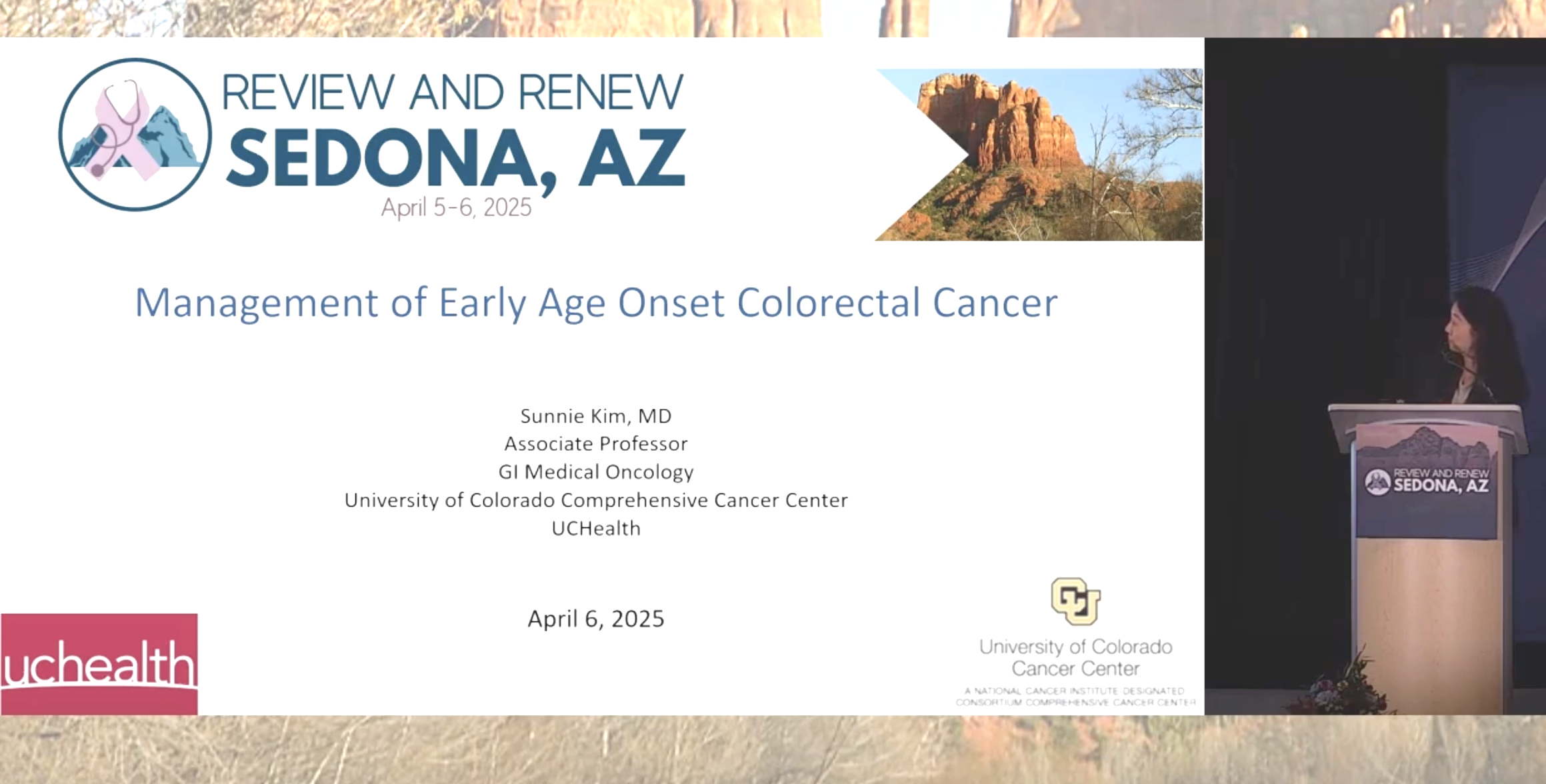
At the 2025 Sedona Review and Renew meeting presented by Total Health, Dr Sunnie Kim, a GI medical oncologist at the University of Colorado Comprehensive Cancer Center, focused her unique epidemiologic and clinical complexities of early-onset colorectal cancer (EOCRC). Her talk addressed the surging incidence of EOCRC, a multifactorial risk profile, evolving screening strategies, as well as some of the psychosocial challenges facing this uniquely vulnerable patient population. “It’s really inescapable…” Dr Kim began. “Even though my focus is upper GI cancers, young-onset colorectal cancer is something we’re all seeing in clinic now.”
Rising Incidence in a Young Population
Dr Kim noted that, while overall rates of colorectal cancer (CRC) are declining in older adults, rates in those under 50 have risen sharply. She noted that approximately 49 young individuals are diagnosed with CRC every day in the U.S., and that by year 2030, CRC is now projected to become the leading cause of cancer death among individuals aged 20 to 49. Dr Kim also noted that rectal cancer incidence has surged even more dramatically than colon cancer, with a 124% increase in rectal cancer among those aged 20–34 over the past two decades, and this pattern is not confined to the U.S.; a global shift in incidence is being documented across developed nations. “Something changed after 1960,” Dr Kim emphasized. “This is a generational exposure, and it’s not just one thing.”
Risk Factors: Genetic and Sporadic
In terms of possible contributing factors, Dr Kim noted that about 25% of EOCRC cases are linked to hereditary syndromes, with Lynch syndrome being the most common. Additionally, 30% of patients under 50 have a first-degree relative with CRC. This contrasts with a much smaller proportion (10–15%) of hereditary involvement in older adults. She noted that the National Comprehensive Cancer Network (NCCN) recommends that all patients with EOCRC be referred for genetic counseling and panel testing, which should include assessment of mismatch repair (MMR) genes and other potential genetic alterations such as APC, MUTYH, and SMAD4. The remaining 75% of EOCRC cases, Dr Kim noted, are sporadic, and the risk factors here are complex and intertwined. These include a shift in dietary trends, with the transition to highly processed, sugar-rich, and red-meat-heavy diets since the 1960s. The current obesity epidemic is another factor, with several studies showing strong correlations between elevated body mass index (BMI) and EOCRC, including the Nurses’ Health Study II, which tracked over 85,000 women aged 25–42. Increases in antibiotic use while still controversial, may be another contributing factor for EOCRC, with a UK-based study suggesting long-term exposure to certain antibiotics (e.g. penicillins) may increase colon cancer risk. A related factor in this regard which Dr Kim noted, is dysbiosis of the normal flora and the gut microbiome. “The gut microbiome is a major research focus, but it’s messy,” she cautioned. “So many factors influence it—diet, antibiotics, environmental toxins—and it’s difficult to determine causation.” Reiterating the multifactorial nature of EOCRC, Dr Kim noted “There is no one cause of EOCRC…It’s likely a complex interplay of genetics, lifestyle, environmental exposures, and microbiome shifts.”
Delayed Diagnosis and Presentation Patterns
Dr Kim emphasized that younger patients will often experience diagnostic delays, partly due to a lack of public and provider awareness. According to one Colorectal Cancer Alliance survey, 63% of survivors were unaware CRC could occur before age 50, and 41% had waited more than 6 months after onset of their symptoms to seek care. Some of the classic symptoms patients and providers should be aware of include rectal bleeding, abdominal pain, fatigue (which can often result from iron-deficiency anemia, as well as diarrhea or changes in bowel habits. Dr Kim also noted a 2023 analysis which found that time to diagnosis shortened with an increasing number of symptoms but still averaged nearly 10 months for patients with just one presenting symptom. “We’re seeing patients dismissed or misdiagnosed—often repeatedly—because they’re 'too young' to have CRC,” she said.
Tumor Biology and Outcomes
Dr Kim also reviewed some of the genomic and biologic differences between younger and older patients with CRC, citing work by Lieu et al., although she emphasized that differences in mutational profiles are not yet clearly actionable for EOCRC. Regarding outcomes, she noted that earlier-stage patients under 50 may fare better overall, but young patients with advanced disease often present later and may do worse than their older counterparts, potentially due to more aggressive tumor biology and treatment delays.
Screening: "45 is the New 50"
Dr Kim emphasized that screening remains the most actionable lever in reducing EOCRC morbidity and mortality. Reviewing the updated guidelines, Dr Kim noted that the American Cancer Society as well as the United States Preventive Services Task Force (USPSTF) now recommend average-risk screening starting at age 45. Screening options in this regard include a colonoscopy every 10 years (the current gold standard method), a FIT or gFOBT annually, cologuard (mt-sDNA) every 3 years, and CT colonography or flexible sigmoidoscopy. Despite the clear benefits of screening, however, Dr Kim notes that only 68% of eligible Americans undergo CRC screening, with lower rates among the uninsured, low-income individuals, and among racial/ethnic minorities. As such, Dr Kim emphasized the need for increased education, and improving access to CRC screening.
Multidisciplinary and Psychosocial Support
A key takeaway from Dr Kim’s presentation was the need for comprehensive, age-appropriate care. She noted that many patients with EOCRC are diagnosed in their 30s or 40s—in the midst of careers, parenting, and fertility planning. As such, Dr Kim has advocated for dedicated early-onset CRC clinics, which offer key resources for EOCRC such as fertility preservation counseling, genetic testing, psychosocial support and survivorship planning, as well as financial navigation, including help with disability paperwork and employment protection considerations. “We can’t ignore the financial toxicities,” she explained. “I had a patient who was the sole breadwinner. Her diagnosis forced her partner to completely change their life trajectory.” Dr Kim also called attention to survivorship needs, noting that recovery often entails physical, emotional, and relational transitions—many of which persist long after treatment ends. “Your life changes after CRC. Fertility, relationships, parenting—all of it. Survivorship care must reflect that.”
Looking Ahead: Research and Advocacy
Dr Kim concluded her presentation with a glimpse of the future, pointing to research efforts like organoids, or “OrganoTakes,” which seek to model EOCRC in lab-based systems that recapitulate colonic architecture and allow for a deeper biologic analysis. Still, she stressed that the real work today lies in education, screening, and advocating for equitable care. She concluded her talk with a poignant clinical story of a young couple, both diagnosed with stage IV CRC while raising a small child. “This is what we’re up against—young people at the height of their lives, raising families, working full time. We owe them better prevention, better care, and better futures.”
You can see the full presentation by Dr Kim from the 2025 Review and Renew Sedona program here.
Speaker Disclosure Information: Dr Kim reported no relevant disclosures for this presentation.