
Clinical Cases in Managing Toxicities with Novel Agents in Hematologic Malignancies
Presenter:
Matthew Ulrickson, MD, Banner MD Anderson Cancer Center
Conference:
2025 Review and Renew Sedona
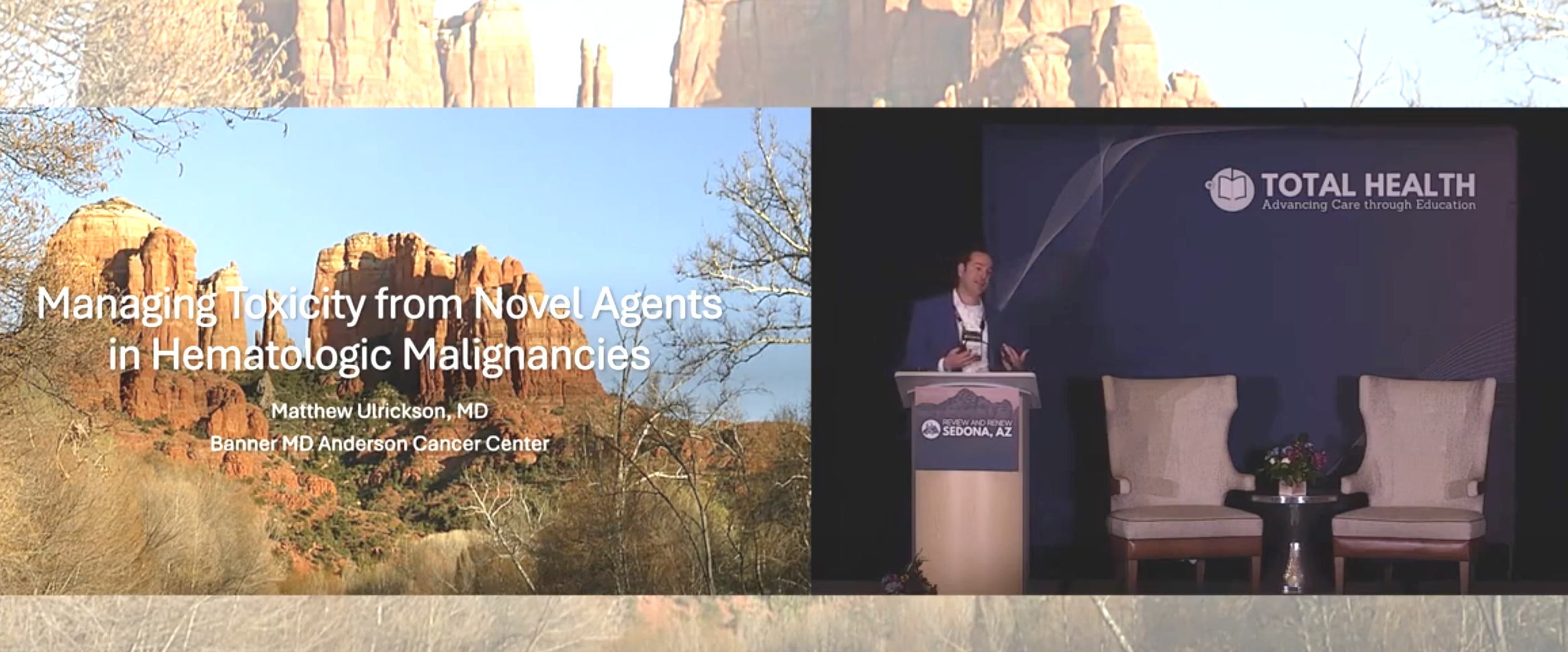
At the 2025 Review and Renew conference in Sedona AZ presented by Total Health, Dr Matthew Ulrickson from Banner MD Anderson Cancer Center delivered a highly practical and forward-looking session on the recognition and management of treatment-related toxicities in the hematologic malignancies. In an era increasingly defined by the use of immunotherapy and targeted agents, he remarked, “This used to just be about chemotherapy—but now it's far more nuanced,” emphasizing how novel therapies are reshaping both efficacy and toxicity landscapes. Dr Ulrickson’s presentation centered around three illustrative cases, each anchoring around the discussion of a distinct therapeutic agent as well as its hallmark adverse event profile: 1) a CD123-targeted therapy in blastic plasmacytoid dendritic cell neoplasm (BPDCN), 2) using menin inhibitors in acute myeloid leukemia (AML), and 3) using bispecific antibodies in lymphoma.
Case 1: Capillary Leak Syndrome with Tagraxofusp in BPDCN
Dr Ulrickson first considered the case of a 72-year-old man presenting with violaceous skin nodules, thrombocytopenia, and bone marrow infiltration, consistent with a diagnosis of blastic plasmacytoid dendritic cell neoplasm (BPDCN). Although rare, BPDCN is clinically striking and often presents first to dermatology. Clinical diagnosis hinges on immunophenotyping, specifically, positivity for CD123, CD4, CD56, and TCL1, with the acronym “123456 + TCL1” providing a helpful diagnostic scaffold. The case in question introduced Tagraxofusp (SL-401)—a CD123-directed cytotoxin—as frontline therapy. This agent delivers a diphtheria toxin payload and is associated with a high risk of capillary leak syndrome (CLS). “This is the reason we admit patients for the first cycle—CLS can be fatal if not recognized early,” Dr Ulrickson warned.
He noted data across trials which suggest a 55% incidence of CLS, though most events are grade 1–2. Risk factors include hypoalbuminemia, rising creatinine, weight gain, and hypotension. Dr Ulrickson emphasized the need for preventive monitoring, with daily weights, serum albumin thresholds (≥3.5 g/dL), and close attention to vital signs.
He contrasted the toxicity profile of Tagraxofusp with that of Pivekimab sunirine, a next-generation CD123-targeted agent using a DNA-alkylating payload, which appears less toxic and can be given outpatient. Though not yet FDA-approved, the agent has shown no CLS to date, with manageable lower extremity edema appearing around cycles 3–4. “This might be a game-changer for community oncologists,” he noted.“Outpatient administration and no CLS? That’s practice changing.”
Case 2: Differentiation Syndrome with Menin Inhibitors in AML
The second case Dr Ulrickson featured considered a 69-year-old woman with KMT2A-rearranged AML, with previous progression on HMA/venetoclax who was treated with the menin inhibitor revumenib. Dr Ulrickson noted this class of drugs has been generating considerable interest for targeting upstream pathways in AML, particularly in the KMT2Ar and NPM1-mutated patient subsets, which together account for ~40% of AML cases.
He noted that, within a week of starting revumenib, the patient developed hypoxia, pleural effusions, and rising blasts—a clinical scenario that can be challenging to interpret. “Is it progression or differentiation?” Dr Ulrickson asked. “This is one of the most critical distinctions with menin inhibitors.” Dr Ulrickson noted that, unlike ATRA or IDH inhibitors, menin inhibitors can induce differentiation while blast counts remain high, making it difficult to differentiate response from relapse. Dr Ulrickson shared data illustrating this phenomenon – specifically noting patients with rising blasts and effusions who later achieved complete remission.
Dr Ulrickson noted that management of differentiation syndrome (DS) involves the use of corticosteroids (although less effective than with ATRA), cytoreduction (e.g., using hydroxyurea or low dose cytarabine), and withholding the menin inhibitor, particularly in the presence of symptoms like effusions, fever, or hypoxia. He further suggested using immunophenotypic flow cytometry to assess whether circulating blasts resemble the leukemia-associated profile or are evolving toward normal myeloid cells. “Be patient,” Dr Ulrickson urged. “What looks like progression might just be the first sign that the drug is working.”
Case 3: Cytokine Release Syndrome with Bispecific Antibodies
The final case Dr Ulrickson considered was a 62-year-old woman with relapsed diffuse large B-cell lymphoma (DLBCL), who developed fever and hypoxia 24 hours after initiating glofitamab, a CD20 x CD3 bispecific antibody (BsAb). He noted the presentation was classic for cytokine release syndrome (CRS)—with fever, tachypnea, and diffuse pulmonary infiltrates. He also reviewed the ASTCT consensus definition for CRS, emphasizing that fever is essential for diagnosis, though it can often be masked by the use of steroids or antipyretics. He further noted that CRS grading hinges on oxygen requirement and blood pressure, with most BsAb-related events limited to grade 1–2. “We don’t need labs to diagnose CRS—but CRP and ferritin can help anticipate it…” he added. Dr Ulrickson noted that BsAbs like glofitamab, epcoritamab, and mosunetuzumab are now widely used for both aggressive and indolent lymphomas, and he reviewed comparative response data and underscored the manageable toxicity of these agents with proper planning.
Dr Ulrickson outlined several CRS Risk mitigation strategies, including, tumor burden reduction (e.g., with the use of bridging chemotherapy before BsAb initiation, steroids “in the pocket” to facilitate outpatient management, primary prophylaxis using tocilizumab, which is now being explored to reduce need for inpatient administration, and lastly the use of inflammatory biomarkers (e.g., CRP >100 mg/L) as a means to flag higher-risk patients. “With lower tumor burden, we’re seeing much lower CRS rates. That makes these agents viable in the community setting” Dr Ulrickson noted. He also advocated for stepwise outpatient protocols, including patient education and emergency plans, to make BsAbs more accessible beyond academic centers.
Closing Insights
Summarizing his presentation, Dr Ulrickson emphasized – based on real-world experience – novel agents require novel vigilance. “Many of these drugs—tagraxofusp, menin inhibitors, bispecifics—have transformed care,” he noted. “But only if we manage their toxicities with the same precision we use to select them.” Whether navigating capillary leak, differentiation syndrome, or CRS, his overarching guidance was to go slow, anticipate, and don’t panic—especially during first cycles of therapy. With novel oral and outpatient therapies increasingly entering the hematologic space, these insights are crucial for both community and academic oncology care teams to keep in mind.
Speaker Disclosure Information: Dr Ulrickson reported the following disclosures for this presentation: Advisory Board/Consultant: Abbvie, ADC Therapeutics, Autolous, Bristol Meyers Squibb, Genentech, Kura, Stemline; Travel Support: Miltenyi; Research Funding (To Institution): ImmunoGen, Kite; Off-label Discussion (not yet FDA approved): pivekimab sunirine in BPDCN.
You can see the full presentation by Dr Ulrickson from the 2025 Review and Renew Sedona conference here.