
Presenter:
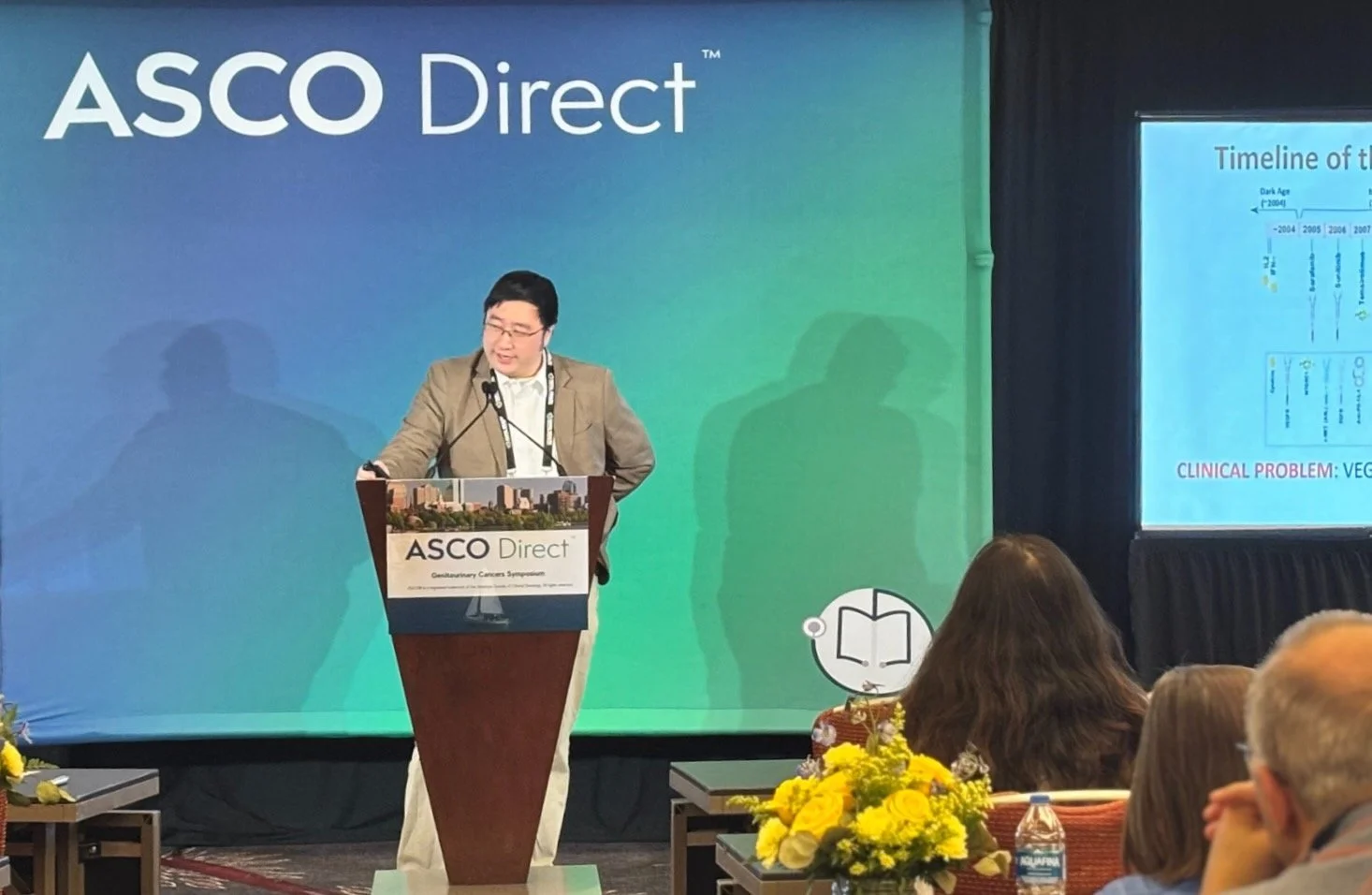
David Gau, PhD, University of Pittsburgh
Conference
ASCO Direct™ GU 2026
Overview
In his presentation at the ASCO Direct™ GU 2026 conference, Dr David Gau from University of Pittsburgh noted that biomarker development in renal cell carcinoma (RCC) currently sits at an inflection point – while the field has generated a broad array of candidates across tissue, blood, and imaging platforms, few have translated into clinically actionable tools. His presentation provided a comprehensive overview of the current biomarker landscape while candidly addressing its limitations. He then transitioned into a more translational discussion of Profilin-1 (Pfn1), a cytoskeletal protein which his laboratory is characterizing as both a prognostic biomarker and a potential therapeutic target. Dr Gau’s overarching message was that while progress has been meaningful, biomarker-driven treatment in RCC is not yet ready for routine clinical implementation.
Clinical Background / Rationale
Despite major therapeutic advances over the past two decades, including the emergence of VEGF-targeted therapies and immune checkpoint inhibitor (ICI) combinations, RCC remains a disease marked by heterogeneous outcomes and incomplete response to therapy. As illustrated in the therapeutic timeline Dr Gau presented, the field has moved into a “golden age” of combination therapeutic strategies, although resistance to VEGF inhibitors and a variability in response to ICIs continue to define clinical practice.
Against this backdrop, he noted that the need for reliable biomarkers is pressing, and emphasized that, unlike other tumor types where biomarker-driven treatment selection is standard, RCC remains very much in an early developmental phase. He framed the biomarker landscape across three domains - tissue-based, liquid biopsy, and imaging/AI-based, with each offering promise but also facing significant challenges in reproducibility, validation, and clinical integration. He noted that overall, “we’re really at the infancy in terms of thinking about biomarkers in kidney cancer.”
Molecular Subtyping and Treatment Selection
Dr Gau then reviewed several landmark efforts to stratify RCC using molecular features, including IMmotion151, BIONIKK, and OPTIC. Collectively, these studies represent some of the most compelling attempts to move beyond clinical risk models toward biologically informed treatment selection. In IMmotion151, for example, patients treated with atezolizumab plus bevacizumab versus sunitinib were retrospectively categorized into molecular clusters, defined by angiogenic signaling, immune infiltration, and proliferative signatures. Similarly, BIONIKK prospectively assigned therapy based on angiogenic versus immune gene expression profiles, while OPTIC further refined this approach by mapping patients to biologic clusters and selecting therapy accordingly. Across these studies, he noted that a consistent pattern emerged: tumors with angiogenic signatures appeared to derive greater benefit from VEGF-directed strategies, whereas immune-inflamed tumors were more responsive to ICI-based regimens. As such, this concept aligns with biological intuition and provides a framework for personalized therapy. Dr Gau was also careful to temper enthusiasm, however, noting that while these stratification approaches demonstrate proof-of-concept, the magnitude of clinical benefit remains modest. In addition, the observed survival differences between molecular subgroups are not yet large enough to justify routine clinical adoption, and assay standardization remains an additional barrier. Overall, Dr Gau emphasized that although molecular profiling can “potentially predict the response of therapies,” the observed differences are “still pretty minor…” and as such he suggests these data remain hypothesis-generating rather than practice-changing.
Liquid Biopsy and Circulating Biomarkers
Dr Gau then shifted to liquid biopsy, an area of intense interest but limited maturity in RCC. Unlike tumor types such as breast or lung cancer, where circulating tumor DNA (ctDNA) has established roles, RCC currently lacks a clearly validated circulating biomarker.
Among available candidates, Dr Gau noted that KIM-1 (kidney injury molecule-1) stands out as one of the most advanced. Data from post hoc analyses of trials such as CheckMate 214, for example, suggest that higher baseline KIM-1 levels are associated with worse outcomes across treatment arms. Moreover, he notes that dynamic changes in KIM-1 may correlate with response, raising the possibility of its use as a monitoring tool. Nevertheless, Dr Gau emphasized that the broader liquid biopsy field in RCC remains fragmented. Circulating tumor DNA (ctDNA) assays, metabolite profiling, and circulating RNA approaches have all been explored, but none have demonstrated sufficient reproducibility across independent datasets. This lack of consistency represents a critical limitation. A slide summarizing current evidence underscored this challenge, with Dr Gau noting that it is not yet possible to determine which analytes represent the most reliable biomarkers due to insufficient replication across studies. In practice, this means that liquid biopsy in RCC remains investigational, with no clear role in guiding treatment decisions today.
Emerging Data: Profilin-1 (Pfn1)
The most novel component of Dr Gau’s presentation focused on Profilin-1, a protein involved in actin cytoskeleton regulation. He positioned Pfn1 as a “fundamental” target, contrasting it with pathway-specific approaches such as VEGF inhibition. His rationale was that targeting core cellular machinery may overcome the redundancy that is inherent in the more commonly targeted cell signaling networks. As Dr Gau put it, “If a cell doesn’t have a functional cytoskeleton, it really can’t do very much”. From a clinical standpoint, Dr Gau emphasized that Pfn1 appears to have both prognostic and biologic relevance. Data presented from prior work demonstrated that Pfn1 is overexpressed in the majority of RCC tumors and that higher expression correlates with more advanced disease, including higher grade, stage, and metastatic burden. Importantly, elevated Pfn1 expression was also associated with shorter overall and progression-free survival, suggesting its potential as a prognostic biomarker. One of the most intriguing findings Dr Gau reviewed was the localization of Pfn1 expression. Rather than being primarily expressed in tumor cells, he noted that Pfn1 was found predominantly in tumor-associated endothelial cells within the microenvironment, an observation which shifted the mechanistic focus from tumor-intrinsic biology to tumor–microenvironment interactions.
Subsequent preclinical experiments which Dr Gau cited provided compelling evidence that endothelial Pfn1 plays a functional role in tumor progression. Overexpression of Pfn1 in endothelial cells led to increased tumor growth and metastatic spread in mouse models, whereas genetic deletion of Pfn1 resulted in tumor regression and reduced metastases. Notably, these effects were observed even in von-Hippel Lindau (VHL)-deficient models, suggesting that Pfn1 operates independently of the canonical RCC pathways. Mechanistically, the effects of Pfn1 also appeared to extend beyond angiogenesis. While loss of Pfn1 impaired vascular formation, overexpression did not significantly increase angiogenesis, likely due to a balance between pro- and anti-angiogenic factors. Instead, Pfn1 influenced immune cell trafficking within the tumor microenvironment. Increased Pfn1 expression, for example, was associated with greater macrophage infiltration and reduced CD8+ T-cell presence, consistent with an immunosuppressive phenotype. Overall, these experimental findings suggest that Pfn1 may function as a regulator of both vascular and immune components of the tumor microenvironment, positioning it as a multifaceted therapeutic target.
Therapeutic Development Targeting Pfn1
Building on these insights, Dr Gau described efforts to pharmacologically inhibit the interaction between Pfn1 and actin. Through the use of a computational screening approach, his group identified small molecules capable of disrupting this interaction, including compounds designated C2 and C74. Preclinical testing demonstrated that these inhibitors indeed reduced tumor cell proliferation, invasion, and angiogenesis, with in vivo studies further showing that treatment with C74 led to reductions in tumor growth and vascular density. Importantly, concerns regarding toxicity, given the ubiquitous role of the cytoskeleton in normal cells, were also addressed in early animal studies. Even at high doses, Dr Gau noted no significant adverse effects observed, although formal toxicology studies with these compounds are ongoing.
To enhance delivery, Dr Gau’s group has also explored the use of microbubble-based systems that allow targeted release of the inhibitor using ultrasound. This theranostic approach offers a novel method to localize treatment while minimizing systemic exposure, though it remains early in development. Finally, Dr Gau noted some exploratory work in chromophobe RCC which suggests that Pfn1 may also play a role in rarer histologies of RCC, with potential mechanisms involving reactive oxygen species and mitochondrial function. While preliminary, he suggested these findings may broaden the potential relevance of Pfn1 beyond clear cell disease.
Practical Considerations and Limitations
Despite the compelling preclinical data presented, several limitations must be acknowledged. Most importantly, Pfn1 research remains at an early, preclinical stage with no current clinical trial data. Translation into human studies will require robust validation, particularly given the theoretical risks associated with targeting a fundamental cellular process. More broadly, the biomarker landscape in RCC continues to be limited by a lack of reproducibility and standardization. Many proposed biomarkers have not been validated across independent cohorts, and few have demonstrated sufficient predictive value to influence treatment selection. Additionally, representation of diverse RCC subtypes remains uneven, with most data focused on clear cell histology. This raises important considerations regarding generalizability, particularly for underrepresented populations and rarer subtypes.
Clinical Takeaways
Dr Gau’s presentation reinforces that biomarker-driven care in RCC remains aspirational rather than actionable. While molecular stratification approaches provide valuable biological insights these strategies are not yet ready to guide therapy in routine practice. Liquid biopsy strategies, while promising, also require further validation before clinical adoption. At the same time, the novel translational research presented on Profilin-1 highlights an exciting frontier for future RCC treatments. By targeting fundamental aspects of tumor biology and the tumor microenvironment, novel approaches such as Pfn1 inhibition may eventually expand the therapeutic landscape. For now, clinicians should view these developments as hypothesis-generating. The immediate implication is not a change in practice, but rather an increased awareness of the complexity underlying treatment response in RCC and the need for continued translational research.
Speaker Disclosure Information: Dr Gau reported no relevant disclosures for this presentation.