
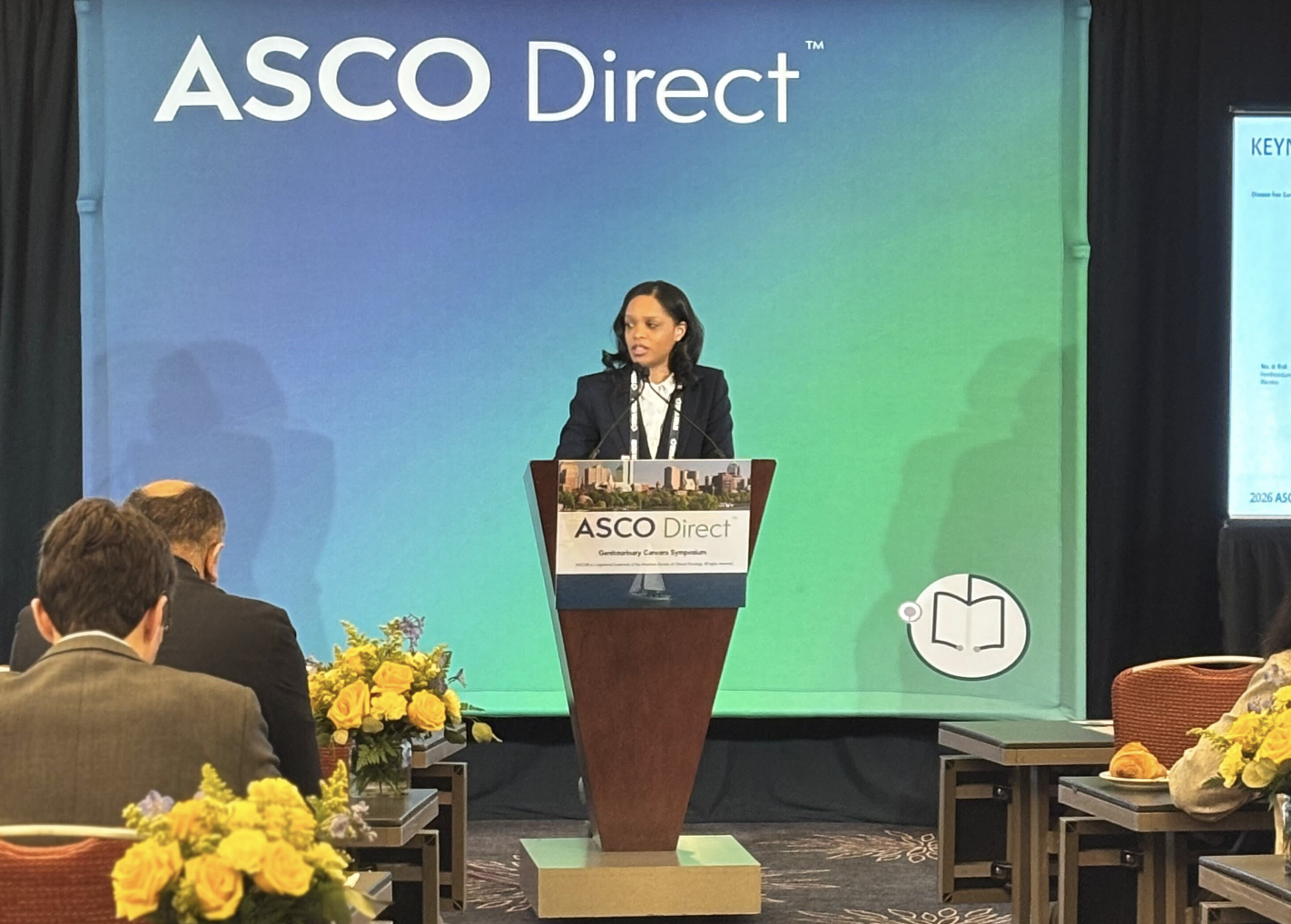
2026 ASCO Direct™ Genitourinary Cancers: Kidney Cancer Highlights
Presenter:
Karie Runcie, MD, Columbia University Irving Medical Center
Conference
ASCO Direct™ GU 2026
Overview
In her presentation at the 2026 ASCO Direct™ GU Conference presented by Total Health, Dr Karie Runcie focused on two of the most important phase 3 renal cell carcinoma (RCC) datasets presented at ASCO GU 2026: LITESPARK-022 in the adjuvant setting and LITESPARK-011 in the post–PD-(L)1 refractory metastatic setting. Collectively, these studies reflect two major themes in contemporary RCC care. The first is the ongoing effort to improve cure rates after nephrectomy without overtreating patients who may already be cured by surgery alone. The second is the search for more effective and durable options after immune checkpoint inhibitor (ICI) exposure in advanced clear cell RCC. Across both studies, has belzutifan emerged as the central agent of interest, although Dr Runcie emphasizes that efficacy gains must be weighed carefully against toxicity, treatment burden, and the still-unresolved need for better patient selection.
Clinical Background / Rationale
Dr Runcie began by framing adjuvant therapy in RCC as essentially a balancing act between efficacy and toxicity as competing priorities. This is especially relevant in the setting of clear cell RCC, where recurrence risk remains substantial for patients with intermediate-high or high-risk disease, although some patients can also be effectively cured with surgery alone: “The goal of adjuvant therapy is to kill that micrometastatic disease to improve cure rates and to prolong overall survival... But it really is a balance of efficacy and toxicity because some of these patients are already cured by resection alone up front” Dr Runcie noted. This historical dilemma in treatment is underscored by the timeline of adjuvant RCC studies which traces decades of largely disappointing efforts with cytokines, vaccines, VEGF TKIs, and other strategies before the field finally saw a meaningful breakthrough with pembrolizumab. Dr Runcie noted KEYNOTE-564, which established adjuvant pembrolizumab as the standard of care by demonstrating both disease-free survival (DFS) and overall survival (OS) benefit. Dr Runcie highlighted the estimated 5-year DFS of 61% with pembrolizumab versus 52% with placebo and an estimated 5-year OS of 88% versus 82%, respectively. Even so, she emphasized that approximately 40% of patients will relapse within 5 years, leaving clear room for improvement in clinical outcomes.
In the metastatic setting, Dr Runcie noted an unmet need that is different but equally pressing. While RCC treatment has advanced rapidly with ICI-based regimens, once disease progresses after anti–programmed death receptor/ligand based [PD-(L)1] therapy, clinicians still face significant uncertainty regarding the next best option. In this regard, Dr Runcie reviewed the growing body of data in the ICI-refractory setting and emphasized the importance not only of treatment response but also of durability of response. That backdrop set the stage for discussion of the LITESPARK-011 study, which tested whether combining HIF-2α inhibition with VEGFR blockade could outperform cabozantinib.
LITESPARK-022 in the Adjuvant Setting
Dr Runcie reviewed findings from LITESPARK-022, a randomized phase 3 trial comparing adjuvant pembrolizumab plus belzutifan with adjuvant pembrolizumab alone in patients with clear cell RCC who were at increased risk of recurrence. This large global study design, with roughly 1,840 patients randomized 1:1 after nephrectomy, included those with intermediate-high-risk disease, high-risk disease, as well as an expanded M1 (no evidence of disease (NED) population, with the primary endpoint being investigator-assessed DFS and OS as the key secondary endpoint.
Dr Runcie noted that the rationale for the combination was biologically appealing, with belzutifan, a HIF-2α inhibitor, already established in refractory clear cell RCC, which may complement pembrolizumab through effects on hypoxia biology and the immune microenvironment. She further cited the impact of hypoxia, which can upregulate PD-L1 expression on suppressive immune cells and that HIF-2α may contribute to immune dysregulation within the tumor microenvironment. She also noted that HIF-2α inhibition may help suppress myeloid-derived suppressor cells, further supporting the biologic rational for a combination strategy. She described the baseline characteristics which were generally balanced between the treatment arms, with about 85% of patients in the intermediate-high-risk category, the majority having grade 3 or 4 tumors, and sarcomatoid features being absent in most cases. Dr Runcie also pointed out that this was a largely international study, with only 12% to 15% of participants enrolled from the United States.
The efficacy signal was positive, with the combination arm improving DFS, with a hazard ratio [HR] of 0.72 and an absolute risk reduction of 7% at 2 years after a median follow-up of 28.4 months. Dr Runcie described this as a 28% relative reduction in the risk of recurrence, with early separation of the curves beginning around 2 months and being maintained over time. She also noted that the M1 NED and highest-risk subgroups appeared to derive a less obvious benefit, although the numbers in this regard were small and the biology of disease may differ in those populations.
OS data in the trial, however, remain immature, with a HR of 0.78, but with only a fraction of the required events having been observed this far, and a modest 0.5% absolute difference in OS seen at 2 years. Accordingly, Dr Runcie stressed that the adjuvant field has learned repeatedly to wait for mature data before drawing definitive conclusions. Overall, she noted the regimen improved DFS versus the current standard of pembrolizumab alone, but OS data are still immature, and better biomarkers are needed to identify which patients may truly benefit from the regimen.
In terms of toxicity the rate of grade 3 or higher treatment-related adverse events (TRAEs) was 42.2% with pembrolizumab plus belzutifan versus 17.9% with pembrolizumab plus placebo, with the most clinically relevant toxicities being anemia and hypoxia, both of which are expected on-target effects of belzutifan. Dr Runcie explained that 12% of patients developed grade 3 or higher anemia requiring transfusion or erythropoietin support, while 5% developed grade 3 hypoxia, with some requiring supplemental oxygen. In her discussion following the presentation, she emphasized the need to be proactive about anemia management, including checking iron and B12 status before starting therapy, considering ESAs in selected patients, and having a lower threshold for dose reduction or discontinuation in the adjuvant setting than in metastatic disease. As she put it, “in the adjuvant setting where some of these patients are maybe cured and we still don’t have a great biomarker to see who’s really benefiting from it, it may be a little bit harder to push patients if they’re having a lot of toxicity.”
“We really need biomarkers [in RCC] to understand which patients will benefit from the adjuvant therapy.”
LITESPARK-011 in ICI-Refractory Advanced RCC
Dr Runcie then reviewed findings from LITESPARK-011, a second major phase 3 study, which addressed a very different but equally important setting: unresectable or metastatic clear cell RCC after anti–PD-(L)1 therapy. This open-label trial randomized 747 patients to belzutifan plus lenvatinib or cabozantinib, with most patients having received one prior line of therapy, and about half having prior VEGFR TKI exposure. Dual primary endpoints were PFS and OS, with overall response rate (ORR) as a key secondary endpoint. The biological rationale for the combination centers on the idea that HIF-2α may be upregulated as a resistance mechanism after anti-VEGF therapy and that combining HIF-2α inhibition with VEGFR blockade may therefore offer broader pathway coverage. Dr Runcie noted the combination may “hit both the HIF1-alpha, HIF2-alpha, and they may be synergistic.”
Dr Runcie cited the impressive efficacy data from the trial, with belzutifan plus lenvatinib improving median PFS to 14.8 months as compared to 10.7 months with cabozantinib, for a HR of 0.70. In addition, she noted that most subgroups favored the combination, although she cautioned that outcomes in the poor-risk group were harder to interpret because of small sample size and wide confidence intervals. Response and durability results were also impressive, with an ORR of 52.6% with belzutifan plus lenvatinib compared with 40% with cabozantinib, and a complete response rate of 5% versus 1%, respectively. More notably, the median duration of response was 23.0 months versus 12.3 months. At 24 months, roughly half of responders remained in response with the combination compared with only about one quarter on cabozantinib, and Dr Runcie singled out this durability as particularly meaningful in a refractory setting where sustained benefit is difficult to achieve. She remarked that “we don’t usually think about a complete response rate in the second-line setting,”and called the near two-year duration of response “pretty impressive.” OS data from this trial again remain immature, but Dr Runcie noted the early trend which favors the combination, with a HR of 0.85, and 2-year OS estimates of 62.8% for belzutifan plus lenvatinib versus 55.4% for cabozantinib. As such Dr Runcie’s emphasized that the data are not yet definitive, but importantly, “it shows that we’re not harming these patients with the combination.”
Dr Runcie also cites tolerability as a key part of the discussion with this regimen, because many clinicians expect lenvatinib 20 mg daily to be difficult to deliver in routine practice. Despite this, the toxicity profile was more favorable than some had anticipated. There was no significant increase in overall toxicity burden with belzutifan plus lenvatinib compared with cabozantinib, although the adverse event profiles differed. Hypoxia and anemia were more prominent with the combination, while diarrhea was more common with cabozantinib. Cardiac dysfunction was also noted with belzutifan plus lenvatinib, including grade 3 or higher events occurring in 4.6%. Treatment discontinuation rates were nearly identical at about 11% in both arms, while VEGFR-TKI dose reductions were actually more frequent with cabozantinib than with lenvatinib. Quality-of-life measures, including FKSI-DRS and EORTC QLQ-C30 global health status/QOL, were similar between arms, and this finding drew attention during post-presentation discussion, as it ran somewhat counter to day-to-day clinical experience. Dr Runcie herself acknowledged that many clinicians are accustomed to dose-reducing lenvatinib and cabozantinib in practice, and she said she was “quite impressed by the toxicity profile” in the trial.
“The durability of response [in LITESPARK-011], I think, was pretty impressive with the combination.”
Safety, Practical Considerations, and Limitations
Across both studies, Dr Runcie cited belzutifan’s unique toxicity profile as a recurring practical issue. Anemia and hypoxia, for example, require a different level of anticipatory management than many oncologists are used to with older RCC therapies. In this regard, Dr Runcie stressed the importance of baseline anemia workup, iron and B12 repletion, ESA use in selected patients, and proactive monitoring. She also highlighted that belzutifan-related hypoxia may be asymptomatic, meaning that patients can have unexpectedly low oxygen saturation without shortness of breath, making pulse oximetry and patient education important.
The limitations of the presented datasets are also important to note. In both LITESPARK-022 and LITESPARK-011, OS results were still immature, and accordingly, the ultimate magnitude of clinical benefit remains unsettled. In the adjuvant setting especially, this matters because the overall tolerance for toxicity is lower when some patients may in fact already be cured. In addition, subgroup findings in the highest-risk patients and M1 NED populations should be interpreted cautiously because of small numbers. Finally, as Dr Runcie emphasized, the field still lacks robust biomarkers to identify who truly needs intensified adjuvant therapy versus who can safely avoid it.
Clinical Takeaways
Dr Runcie’s presentation highlighted belzutifan’s growing importance across RCC disease states. In the adjuvant setting, LITESPARK-022 suggests that adding belzutifan to pembrolizumab can further improve DFS beyond pembrolizumab alone, but that gain comes with meaningful additional anemia and hypoxia risk and without mature OS data. In the refractory metastatic setting, LITESPARK-011 shows that belzutifan plus lenvatinib can deliver better PFS, higher response rates, and a notably greater durability of response than cabozantinib, with manageable toxicity and preserved quality of life.
A practical message was not that every eligible patient should automatically receive these regimens. Rather, Dr Runcie frames both studies as an invitation to more nuanced decision-making in RCC. In the adjuvant setting, clinicians must continue to weigh recurrence risk against toxicity and overtreatment. In the metastatic setting, belzutifan-based combinations now look increasingly competitive as preferred options after PD-(L)1 therapy, especially when durability matters. Across both settings, however, better biomarkers and longer follow-up remain essential before the full place of these regimens in routine practice is fully defined.
Speaker Disclosure Information: Dr Runcie reports the following disclosures for this presentation: Consulting/Advisory Role: Summit Therapeutics Inc. Institutional Research Funding: Xencor, Novartis, Exelixis, Bristol-Myers Squibb, and Johnson & Johnson Innovative Medicine.