
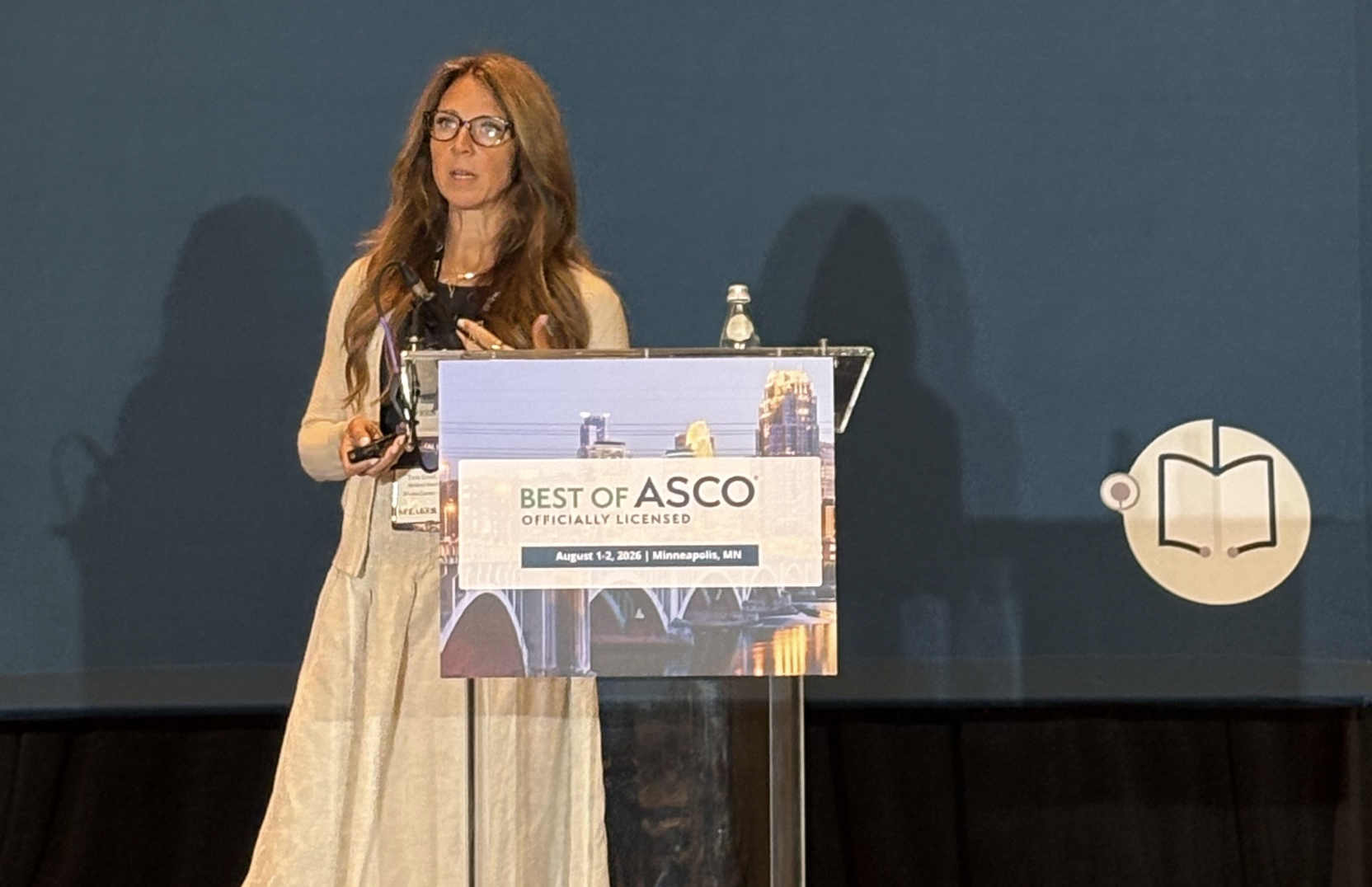
Faculty: Tara Graff, DO, MS, Mission Cancer and Blood
Meeting: Best of ASCO Minneapolis
The Bottom Line
At the 2026 Best of ASCO Minneapolis conference presented by Total Health, Dr Tara Graff used her presentation to review the rapidly evolving treatment landscape in chronic lymphocytic leukemia (CLL), drawing from both ASCO and EHA 2026. Her central message was that modern CLL management is being increasingly defined by risk-adapted targeted therapy, fixed-duration treatment strategies, thoughtful sequencing, and patient preference, rather than by chemoimmunotherapy alone. Variables such as TP53 status, del(17p), IGHV mutation status, cardiovascular comorbidity, as well as patient’s preference for continuous versus time-limited therapy all remain critical to treatment selection.
Dr Graff highlighted several key findings, including long-term follow-up from CLL14 and SEQUOIA that reinforced the durability of venetoclax/obinutuzumab and zanubrutinib in the frontline setting. In addition, she noted early-phase data with sonrotoclax plus zanubrutinib which suggest that deeper molecular remissions may be achievable with a fully oral, fixed-duration strategy. Pirtobrutinib also continues to move earlier in the treatment course, with data supporting both frontline monotherapy and fixed-duration combination treatment after covalent Bruton tyrosine kinase (BTK) inhibitor exposure. Finally, real-world data with lisocabtagene maraleucel (liso-cel) suggested that cellular therapy may be more clinically relevant in relapsed/refractory CLL than initial trial data had initially implied.
Frontline CLL: Fixed-Duration Therapy Remains Highly Effective
Dr Graff began by emphasizing a fundamental principle of CLL treatment – that is, not every patient with newly diagnosed disease requires immediate therapy. Treatment should begin only when standard International Workshop on Chronic Lymphocytic Leukemia (iwCLL) indications develop, such as progressive marrow failure, symptomatic adenopathy or splenomegaly, constitutional symptoms, rapid lymphocyte doubling, or symptomatic extranodal disease. Once treatment is indicated, modern decision-making requires molecular risk stratification and discussion of treatment duration and toxicity.
To illustrate the value of fixed-duration therapy, Graff revisited the phase III CLL14 trial, which compared venetoclax plus obinutuzumab with chlorambucil plus obinutuzumab in treatment-naive patients with comorbidities. She cited nine-year follow-up presented at EHA 2026 which show a durable benefit with venetoclax/obinutuzumab, with median PFS of 76.6 months compared with 37.9 months with chlorambucil/obinutuzumab. Importantly, the long-term data also illustrated that disease biology continues to matter even with highly effective targeted therapy. Among patients receiving venetoclax/obinutuzumab, median PFS was 79.2 months in those without TP53 aberrations versus 49.0 months in those with TP53 deletion or mutation. Similarly, median PFS was 104.9 months in patients with mutated IGHV compared with 64.7 months in patients with unmutated IGHV. Dr Graff used these data to reinforce the premise that that fixed-duration venetoclax/obinutuzumab remains highly effective, but that clinicians should not assume all patients will derive the same duration of benefit.
SEQUOIA Confirms the Durability of Frontline Zanubrutinib
Dr Graff then discussed findings from the 7-year update of the phase III SEQUOIA trial, which has provided some of the most mature data for continuous frontline BTK inhibition. In cohort 1, treatment-naive patients without del(17p) were randomized to zanubrutinib or bendamustine/rituximab (BR). At a median follow-up of 84 months, she noted that 53.9% of patients initially assigned to zanubrutinib remained on treatment. PFS also continued to strongly favor zanubrutinib, with a hazard ratio [HR] of 0.28. At 78 months, estimated PFS was 71.8% with zanubrutinib versus 31.0% with BR, and benefit was observed regardless of IGHV status, including both unmutated and mutated disease. Emphasizing the degree of separation in PFS, Dr Graff remarked: “You can drive a Mack truck through these curves.” Time to next treatment also significantly favored zanubrutinib, with 78-month rates of 87.0% versus 53.0% for BR. PFS2 also favored zanubrutinib, supporting the concept that using a BTK inhibitor first does not appear to compromise the effectiveness of subsequent treatment. Among patients who progressed after zanubrutinib and received BCL2 inhibitor–based salvage, most remained alive and progression free after more than 3 years of follow-up. Dr Graff also noted the safety profile, which remained consistent with known class effects. Zanubrutinib was associated with more bleeding and bruising, whereas BR produced more cytopenias. She emphasized that these long-term sequencing data support zanubrutinib as a durable frontline option while preserving the activity of later BCL2-directed therapy.
Sonrotoclax Plus Zanubrutinib: A Next-Generation Fixed-Duration Strategy
Dr Graff then shifted to a discussion of emerging all-oral fixed-duration treatment. In this regard, she noted sonrotoclax, a next-generation BCL2 inhibitor designed to be more selective and potent than venetoclax, with a shorter half-life and less accumulation. In the phase I/IB BGB-11417-101 trial, sonrotoclax was combined with zanubrutinib in treatment-naive CLL/SLL. The regimen began with an 8- to 12-week zanubrutinib lead-in, followed by sonrotoclax ramp-up to 160 or 320 mg. Among 137 treated patients, Dr Graff cited the100% overall response rate (ORR), with complete responses observed in 51.0% of patients in the 160-mg cohort and 59.5% in the 320-mg cohort. The depth of response was also particularly notable. In the 320-mg cohort, best peripheral blood uMRD4 rates were 81.2% by week 24, 91.8% by week 48, and 98.2% by week 96, and uMRD4 rates were high regardless of IGHV or del(17p)/TP53 status. At approximately 31 months of follow-up, she noted that no progression had been observed in the 320-mg cohort, including patients who had electively discontinued therapy after protocol-defined treatment completion. Safety in the trial was manageable, with no occurrences of clinical or laboratory tumor lysis syndrome, and no treatment-emergent adverse event leading to death. Neutropenia was the most important grade ≥3 toxicity. Overall, Dr Graff viewed the depth of MRD negativity as particularly encouraging because the goal of adding BCL2 inhibition to a BTK inhibitor is to eradicate residual disease and potentially enable durable treatment-free intervals. She further noted that these findings are being tested prospectively in CELESTIAL-TNCLL-2, which compares fixed-duration sonrotoclax/zanubrutinib with venetoclax/acalabrutinib. Dr Graff highlighted that this study includes high-risk patients with unmutated IGHV and/or TP53 aberrations, helping address a population excluded from some earlier fixed-duration comparisons.
Pirtobrutinib Moves Earlier in Treatment
Dr Graff also cited the continued movement of pirtobrutinib, a noncovalent BTK inhibitor, earlier in the CLL treatment sequence, noting a pooled analysis of BRUIN CLL-313 and BRUIN CLL-314 that evaluated pirtobrutinib monotherapy in treatment-naive CLL/SLL. Across 253 patients, the investigator-assessed ORR was 93.3%, 24-month PFS was 93.2%, and 24-month OS was 97.5%; median PFS and OS were not reached. The safety profile was also favorable, with treatment discontinuation due to treatment-emergent adverse events observed in only 4.8% of patients and treatment-related discontinuation in 1.6%. Rates of atrial fibrillation/flutter, hypertension, and major hemorrhage were relatively low. Summarizing the overall trajectory of pirtobrutinib, Dr Graff noted: “Third line, second line, and now into front line…” and she believes the pooled analysis strengthens the case for pirtobrutinib as a potential initial BTK inhibitor rather than only a rescue strategy after failure of a covalent BTK inhibitor.
BRUIN CLL-322: Fixed-Duration Pirtobrutinib After Covalent BTK Inhibition
Shifting to the relapsed/refractory setting, Dr Graff highlighted BRUIN CLL-322, which evaluated fixed-duration pirtobrutinib plus venetoclax and rituximab (PVR) against venetoclax/rituximab (VR). Approximately 80% of enrolled patients had previously received a covalent BTK inhibitor, making the study particularly relevant to contemporary treatment sequencing. At a median follow-up of 27.3 months, PVR reduced the risk of progression or death by 45% compared with VR (HR = 0.547), with a 24-month PFS rate of 86.9% with PVR versus 71.8% with VR. Notably, the benefit was maintained in patients previously treated with a covalent BTK inhibitor, including those who had progressed on that therapy, and in patients with high-risk molecular features. MRD responses were also deeper with PVR; among patients with evaluable end-of-treatment samples, uMRD4 was achieved in 86% of patients receiving PVR versus 61% receiving VR, although Dr Graff did note that missing MRD data in much of the intent-to-treat population limited interpretation of these data. Importantly, Dr Graff noted that adding pirtobrutinib did not substantially worsen the overall safety profile. Treatment-related discontinuation rates were similar between groups, and pirtobrutinib retained a favorable cardiovascular profile. As such, the findings support PVR as a potential fixed-duration option for previously treated CLL, particularly after covalent BTK inhibitor exposure.
CAR T-Cell Therapy May Be More Relevant Than Previously Thought
Dr Graff concluded her presentation with some real-world data evaluating CAR-T cells (liso-cel) in relapsed/refractory CLL. In TRANSCEND CLL 004, Dr Graff cited the initially observed ORR of 48% and the CR/CRi rate of 18%, results that she and others described as somewhat underwhelming relative to expectations. Despite this, however, the first CIBMTR real-world analysis was more encouraging. Fifty-nine patients treated commercially with liso-cel had a median age of 63 years, a median of six prior lines of therapy, and 65% had at least one comorbidity. Notably, 44% received infusion in the outpatient setting. At a median follow-up of approximately 6 months, ORR was 83% and CR rate was 55%. Six-month duration of response exceeded 89%, while PFS and OS were approximately 80% and 90%, respectively. Grade ≥3 cytokine release syndrome occurred in 5%, and grade ≥3 ICANS in 10%. Dr Graff felt these data could impact the perception of CAR T-cell therapy in CLL, noting: “I think this really changes the narrative a little bit.” She suggested that liso-cel might deserve greater consideration, particularly for younger, higher-risk patients who have received multiple prior lines of therapy.
Conclusions and Faculty Insights
Dr Graff’s review of the current ASCO/EHA data in CLL underscores how quickly CLL treatment is evolving from a sequence of individual targeted agents into a more sophisticated strategy built around depth of response, treatment duration, molecular risk, and preservation of future options. Long-term follow-up from CLL14 and SEQUOIA confirm that both fixed-duration venetoclax/obinutuzumab and continuous zanubrutinib can deliver durable frontline disease control, while also reminding clinicians that TP53 and IGHV status remain highly relevant. Sonrotoclax plus zanubrutinib may further improve the depth of fixed-duration therapy, with very high MRD-negative rates in early-phase testing. Pirtobrutinib is also rapidly changing position within the treatment algorithm, with frontline pooled data supporting its efficacy and tolerability, and BRUIN CLL-322 suggesting that fixed-duration pirtobrutinib/venetoclax/rituximab may become a strong option after covalent BTK inhibitor exposure. Lastly, real-world liso-cel results suggest that cellular therapy may have a larger role in appropriately selected, heavily pretreated patients than early trial experience initially suggested.
Dr Graff’s presentation also suggested that BTK inhibitors should not necessarily be viewed as interchangeable, and that treatment choice should increasingly be individualized around biology, toxicity, treatment duration, and patient goals. In an era when many patients may receive only one or two major treatment lines over the course of their disease, choosing the right first therapy - and thereby preserving effective options for what comes next - has become central to long-term CLL management.
Speaker Disclosure Information: Dr Graff reported no relevant disclosures for this presentation.