
Future Directions in GI Cancers: What to Expect by ASCO 2027
Presenter:
Steven Maron, MD, MSc; Memorial Sloan Kettering Cancer Center
Conference:
Best of ASCO GI 2026
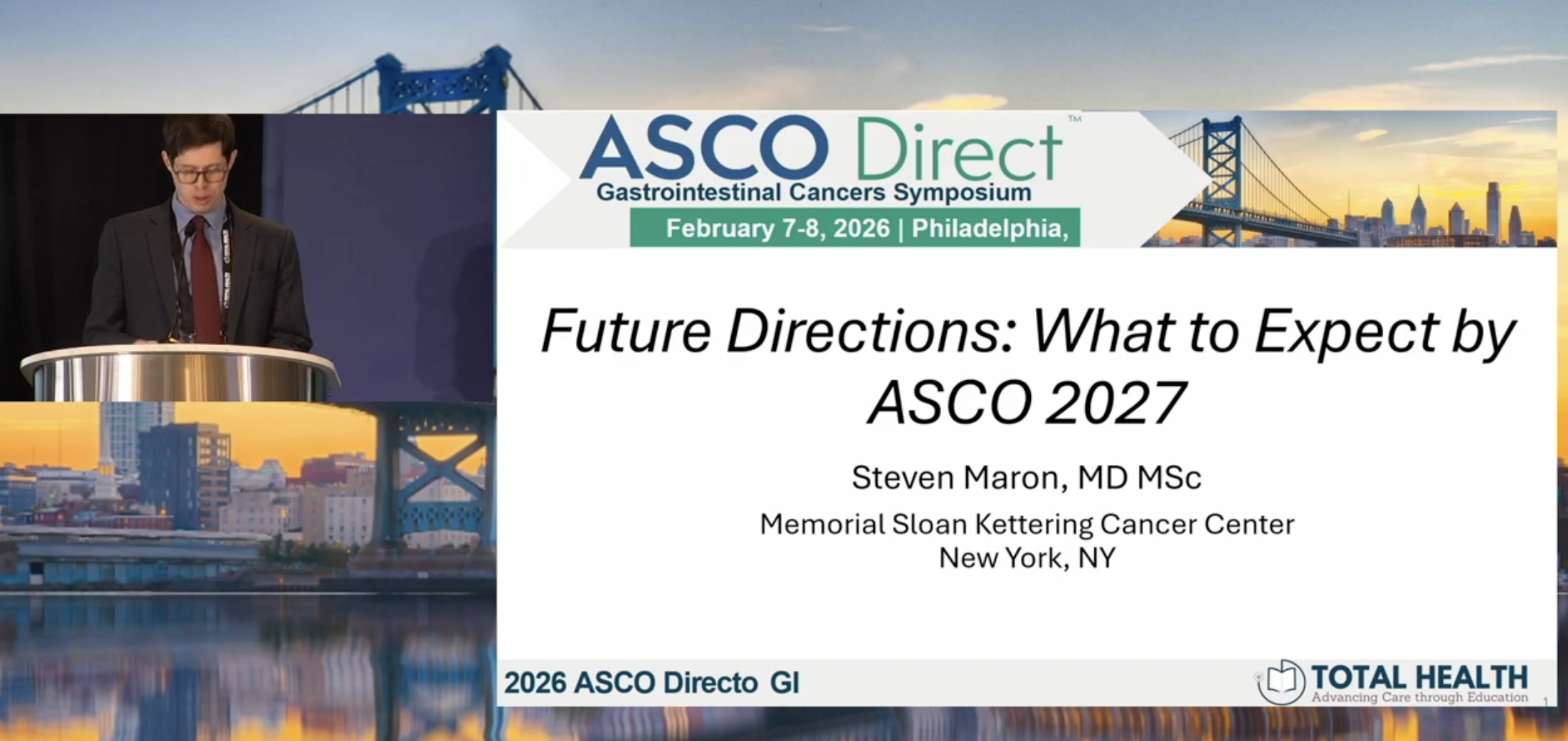
In the closing presentation of Best of ASCO GI 2026, Dr Steven Maron from Memorial Sloan Kettering Cancer Center provided a forward-looking overview of major therapeutic developments that are likely to shape gastrointestinal oncology over the next several years. Rather than focusing on a single tumor type, Dr Maron highlighted emerging trends in esophagogastric cancer, pancreatic ductal adenocarcinoma (PDAC), and colorectal cancer (CRC) that may substantially alter clinical practice by the time of the 2027 ASCO Annual meeting. He noted several key areas of innovation, including the rapid expansion of Claudin18.2-targeted therapies, next-generation HER2-directed agents, emerging KRAS inhibitors in pancreatic cancer, new frontline strategies for BRAF V600E–mutated colorectal cancer, and the intriguing possibility that GLP-1 receptor agonists may be associated with reduced colorectal cancer incidence. Dr Maron framed the session around a simple but important question: “What are we really seeing that’s going to transform our care in GI oncology?”
Esophagogastric Cancer: Expanding Targeted Therapy Options with Claudin18.2 Targeting
One of the most significant recent developments in gastric and gastroesophageal junction cancers has been the emergence of therapies targeting Claudin18.2 (CLDN18.2). Dr Maron noted the phase 3 trials SPOTLIGHT and GLOW which have demonstrated that adding the monoclonal antibody zolbetuximab to chemotherapy improves progression-free (PFS) and overall survival (OS) in patients with CLDN18.2-positive tumors. These studies established CLDN18.2 as a clinically actionable target in > 40% of patients with esophagogastric adenocarcinoma. Dr Maron cautioned, however, that the response and survival benefit observed in these trials has been relatively modest and that managing its toxicity remains challenging.
Citing more recent results, Dr Maron reviewed findings from the ILUSTRO trial, which explored the prospect of adding immune checkpoint inhibition to this strategy. Preliminary results suggested that combining zolbetuximab, chemotherapy, and nivolumab may significantly improve response rates (RR) and PFS, as compared with historical data observed in SPOTLIGHT and GLOW. Dr Maron noted that these findings are now being further tested in the phase 3 LUCERNA trial, which will evaluate zolbetuximab plus chemotherapy and pembrolizumab versus chemotherapy plus pembrolizumab alone. He noted that, if positive, the strategy could establish a new frontline standard for CLDN18.2-positive metastatic esophagogastric cancer.
Next-Generation CLDN18.2 Therapies
Dr Maron also emphasized that zolbetuximab may represent only the first generation of CLDN18.2-targeted agents. Indeed, he noted that more than 50 investigational agents targeting this pathway are currently under development, including T-cell–engaging bispecific antibodies, antibody–drug conjugates and novel monoclonal antibodies. He cited early clinical data for CLDN18.2-directed T-cell engagers which have been particularly encouraging. For example, early-phase trials combining CLDN18.2-targeting bispecific antibodies with chemotherapy and immunotherapy have reported objective response rates (ORRs) as high as 83% at higher dose levels, with survival data still pending. Dr Maron suggests that these next-generation approaches could eventually replace first-generation monoclonal antibodies such as zolbetuximab: “With the rate of development of these drugs, I suspect these will surpass zolbetuximab shortly,” he said. He also noted multiple phase 3 trials evaluating CLDN18.2-targeted therapies which are expected to report results between 2026 and 2027, potentially reshaping the frontline treatment paradigm.
HER2-Positive Gastroesophageal Cancer
Another major area of development which Dr Maron highlighted involves HER2-targeted therapy in esophagogastric cancers. He noted the KEYNOTE-811 trial, for example, which has established the current standard of care by demonstrating that adding pembrolizumab to trastuzumab and chemotherapy improves RR and survival in HER2-positive disease. Newer agents, however, may further enhance outcomes. Dr Maron highlighted the HERIZON-GEA-01 trial, for example, which evaluated the biparatopic HER2 antibody zanidatamab combined with chemotherapy, with or without the PD-1 inhibitor tislelizumab, compared with standard trastuzumab-based therapy. The results showed substantial improvements in PFS and OS with zanidatamab-based regimens, and, although the trial did not directly compare zanidatamab with the current KEYNOTE-811 regimen, the magnitude of benefit suggests that this strategy could become a new frontline standard. “HERIZON clearly beats ToGA, and we suspect it will likely beat KEYNOTE-811 as well,” he said, and Dr Maron predicted that zanidatamab could ultimately replace trastuzumab in frontline HER2-positive metastatic gastroesophageal cancer.
Pancreatic Cancer: The Rise of KRAS Inhibition
Pancreatic ductal adenocarcinoma (PDAC) remains one of the most challenging malignancies to treat, but advances in targeting KRAS mutations may soon change this landscape. KRAS alterations occur in approximately 90% of pancreatic cancers, making them a central driver of tumor biology. While KRAS inhibitors targeting the G12C mutation are already approved in some cancers, newer agents are being developed to target additional KRAS variants common in pancreatic cancer, including G12D.
In this regard, Dr Maron highlighted promising data for RMC-6236, a pan-RAS inhibitor currently under investigation. In early studies in previously treated pancreatic cancer, the drug achieved ORRs approaching 35%, and a median PFS ranging from 8.5 to 13 months. He noted these results as being particularly notable given the historically limited efficacy of second-line therapies in pancreatic cancer: “When have we ever seen this sort of data in second-line pancreas cancer?” He also noted the ongoing RASolute 302 phase 3 trial which will provide more definitive evidence regarding the role of pan-RAS inhibition in PDAC. If successful, Dr Maron believes that KRAS-targeted therapies could represent one of the most important therapeutic advances in pancreatic cancer in decades.
Colorectal Cancer: Targeted Therapy Moves to the Frontline
In colorectal cancer, Dr Maron focused on advances for tumors harboring the BRAF V600E mutation, which historically has been associated with poor prognosis. He cited the BEACON trial which established the combination of encorafenib plus cetuximab as a standard treatment for previously treated BRAF V600E–mutant metastatic CRC, and more recently, the BREAKWATER trial, which has explored moving this targeted strategy into the frontline setting. Early results from BREAKWATER showed that combining FOLFOX with encorafenib and cetuximab significantly improved outcomes compared with chemotherapy alone. Dr Maron also cited new data presented at ASCO GI which evaluated a similar approach using FOLFIRI instead of FOLFOX. The combination of FOLFIRI plus encorafenib and cetuximab improved ORR from 39% to 64.4%, achieving the primary endpoint of the study. Although overall survival data remain immature, Dr Maron noted the findings suggest that targeted therapy combinations could become standard first-line treatment for BRAF-mutant colorectal cancer, and that guideline updates are already beginning to reflect this shift. “BREAKWATER led to FOLFOX plus encorafenib and cetuximab in the guidelines, and I suspect FOLFIRI will be joining it shortly,” Dr Maron said.
Prevention and Risk Reduction in Colorectal Cancer
In addition to therapeutic advances, Dr Maron highlighted emerging research exploring potential strategies for colorectal cancer prevention. Previous studies, for example, have demonstrated that aspirin may reduce recurrence in patients with PIK3CA-mutated colorectal cancer, findings that were recently confirmed prospectively in the ALASCCA trial. More unexpectedly, Dr Maron also cited observational data which have suggested that GLP-1 receptor agonists, now commonly used for diabetes and obesity, may also influence colorectal cancer risk. In a large retrospective analysis of nearly 300,000 patients, GLP-1 inhibitor use was associated with a 36% reduction in colorectal cancer incidence compared with matched control populations. He noted that, although these findings remain exploratory, they raise intriguing questions about the role of metabolic therapies in cancer prevention, and he emphasized that prospective studies will be necessary before such strategies can influence clinical practice.
Clinical Takeaways
Dr Maron concluded his presentation by suggesting that the next several years are likely to bring substantial disruption to the treatment landscape across gastrointestinal malignancies. He cited some of the key areas to watch, which include:
Expansion of CLDN18.2-targeted therapies in esophagogastric cancer
Potential approval of zanidatamab-based regimens in HER2-positive disease
Emerging KRAS-targeted therapies for pancreatic cancer
Frontline targeted strategies for BRAF-mutant colorectal cancer
Ongoing research into pharmacologic prevention of colorectal cancer
As Dr Maron summarized in his closing remarks: “First-line therapy is dramatically changing in esophagogastric cancer, and KRAS inhibition may soon be a game changer in pancreatic cancer.” With multiple pivotal trials expected to report results in the next two years, clinicians can anticipate a rapidly evolving GI oncology landscape by the time of the 2027 ASCO meeting.
Speaker Disclosure Information: Dr Maron reports the following disclosures for this presentation: Consulting or stock ownership: Novartis, Amgen, Elevation Oncology, Pinetree Therapeutics, Purple Oncology, Bolt Therapeutics, Everest Medicines; Research funding/support: Paige.AI, AstraZeneca, OneCell.Dx, Guardant Health; Equity: OneCell.Dx; Grant support: Conquer Cancer Foundation; Travel funding: AstraZeneca.